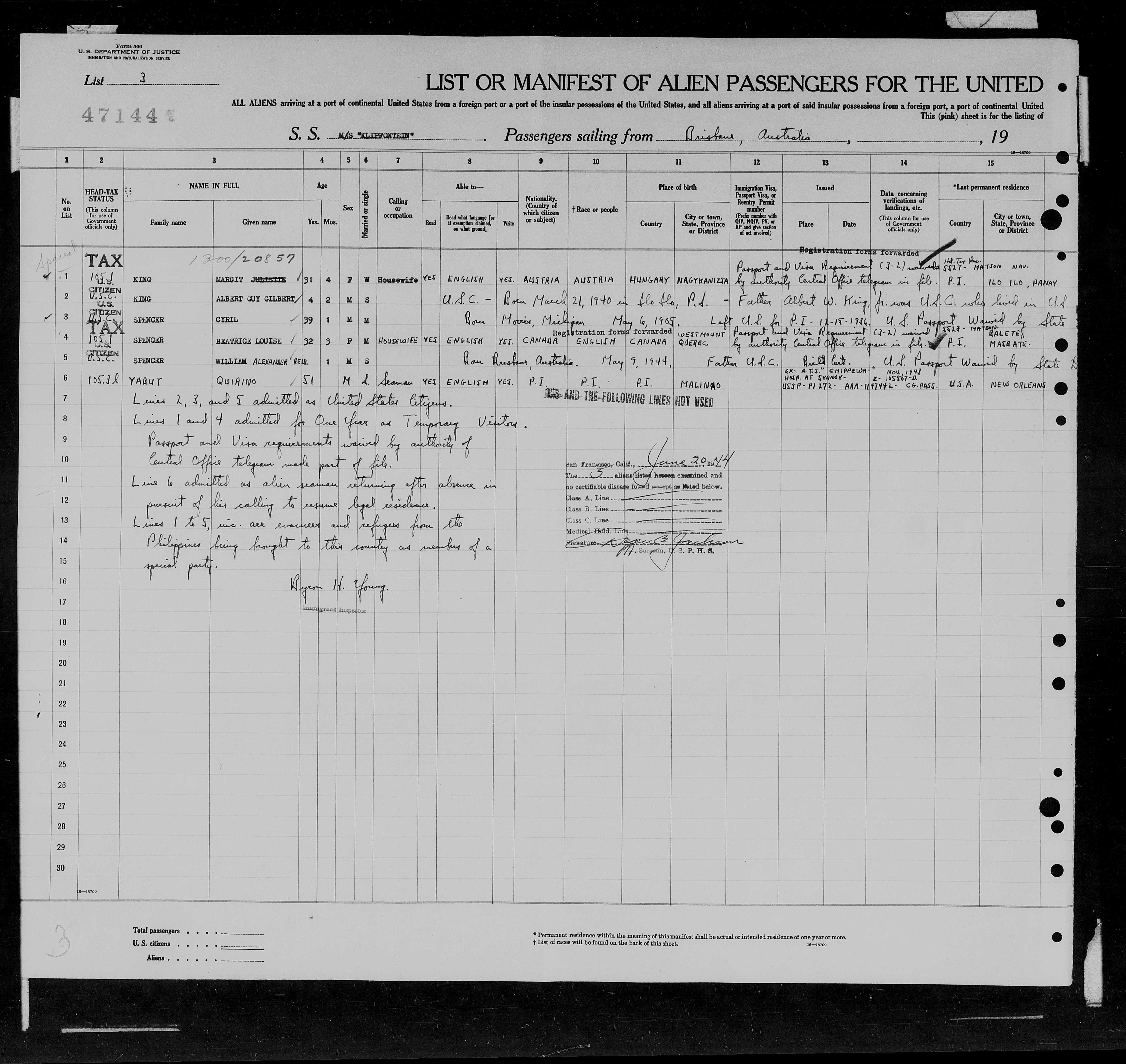
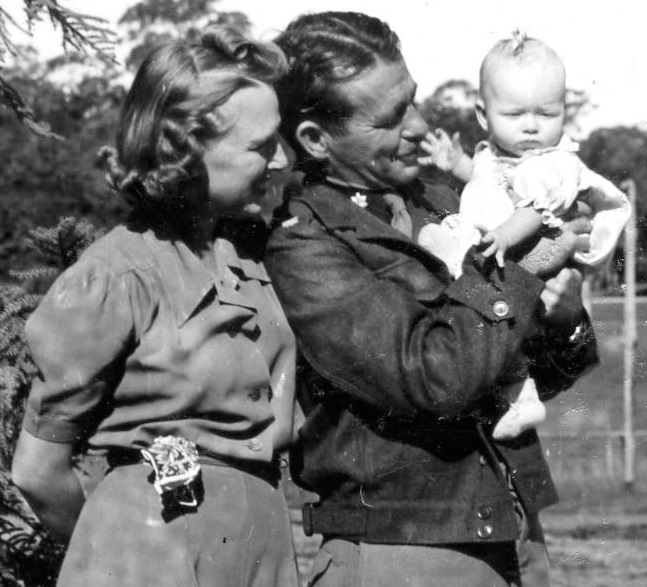
 #10 Laverne Blanche Fertig, #9 Claude E. Fertig #11 Susan Beatrice Fertig Photo taken after arriving in Australia 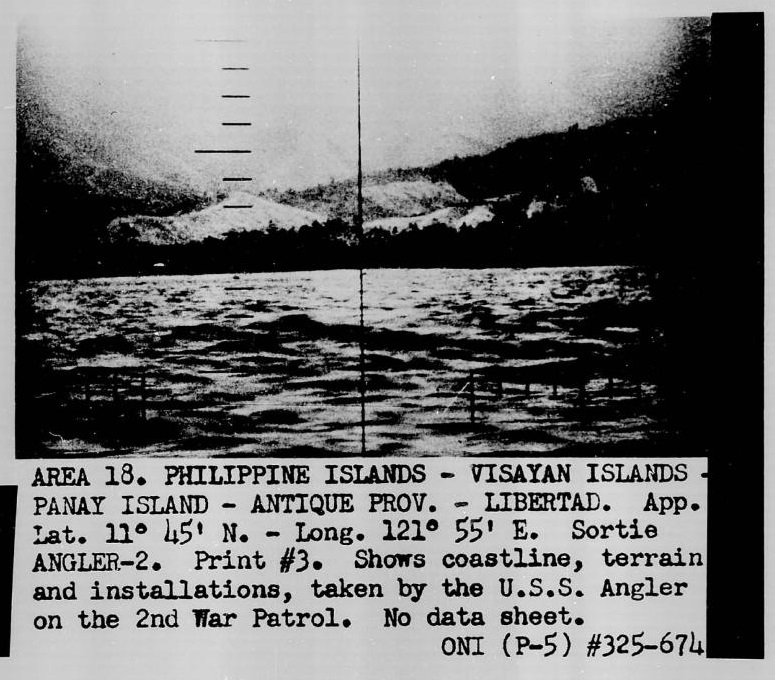 U.S.S. Angler Periscope Photo during the evacuation 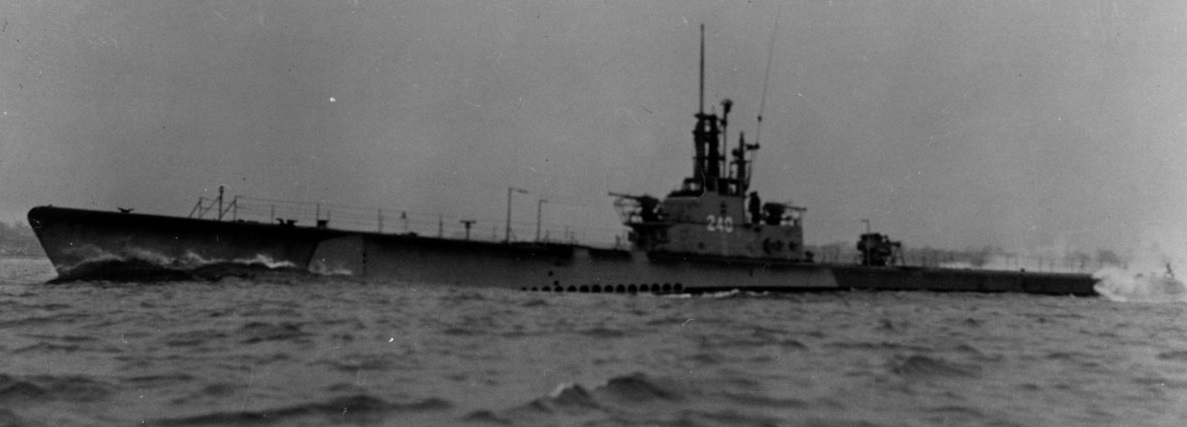 U.S.S. Angler SS 240 |
Magdalena Caspe was adopted by the Smith Family and became Magdalena Caspe Smith or simply Magdalena Smith. She later went by her married name Magdalena Smith Villaruz or Magdalena Villaruz. She was a noted inventor of agricultural machineries.
See: Magdalena Caspe
U.S.S. ANGLER (SS240)
EVACUATION PARTY
MARCH 20TH, 1944
PANAY ISLAND, P.I.
1. ANTIKOLL, Carlos Fernandez
Private U.S. Army, Enlisted Aug. 6, 1943, Special Order #119 P.I.
Male, Born June 18 1911, Santa Mesa, San Juan, Rizal, P.I.
American
(Carlos Fernandez Antikoll)
American Guerrillas in the Philippines
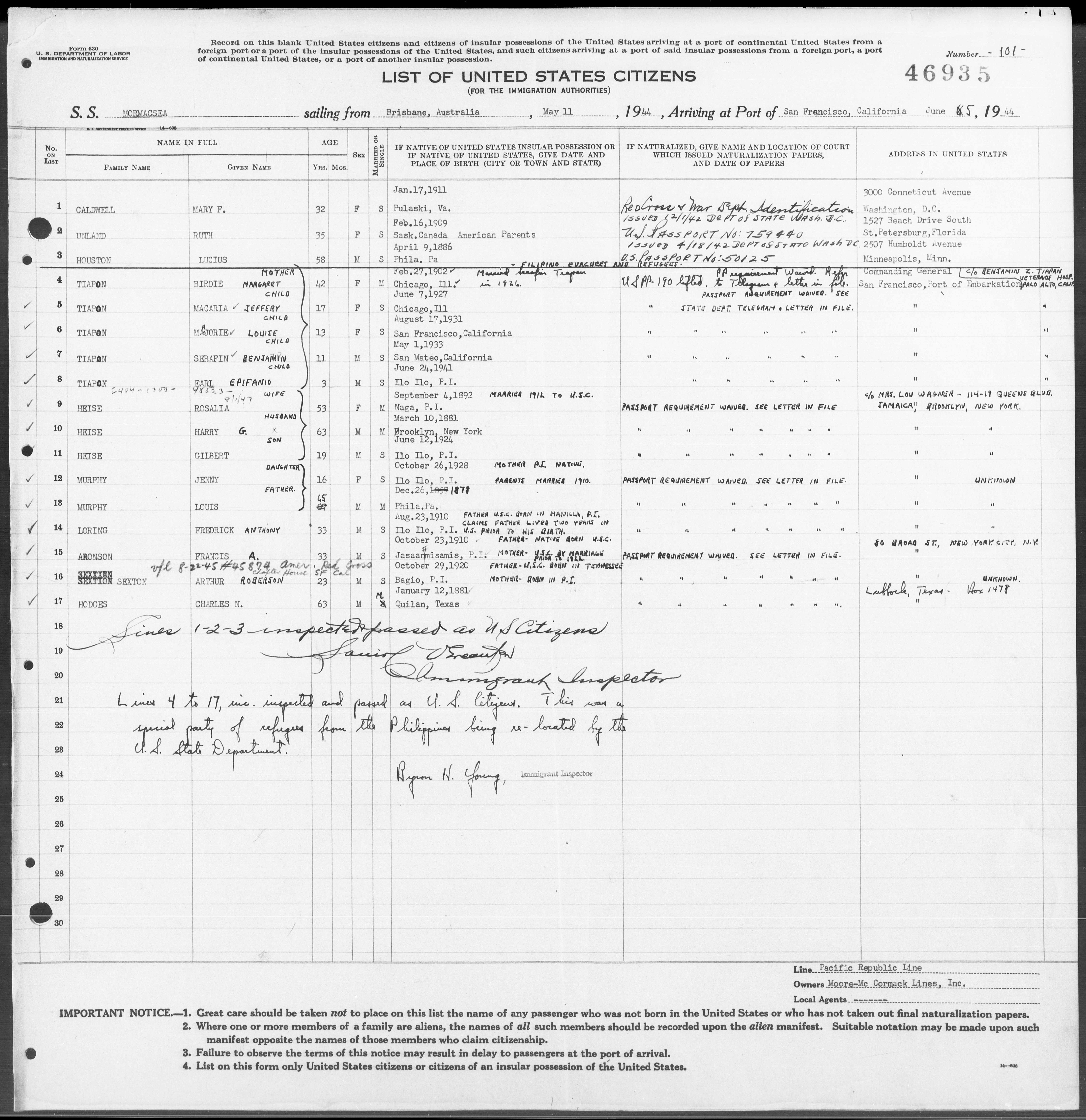
2. ARONSON, Francis
1st Lieut. U.S. Army, 6th M.O. Q.M.S.
Male, Born Oct. 23 1910, Jasaan Misamis
American
(Francis Aronson, Francis A. Aronson)
arrival1944may11
American Guerrillas in the Philippines
3. BEARDEN, Clarence David
Staff Sarg., U.S. Army Air Corps, Enlisted Sept. 11 1939, #69-708-69
Male, Born Sept. 4 1918, Eldorado Ark. U.S.A.
American
(Clarence David Bearden, Clarence David Bearden Jr.)
American Guerrillas in the Philippines
https://www.findagrave.com/memorial/43832535/clarence-david-bearden
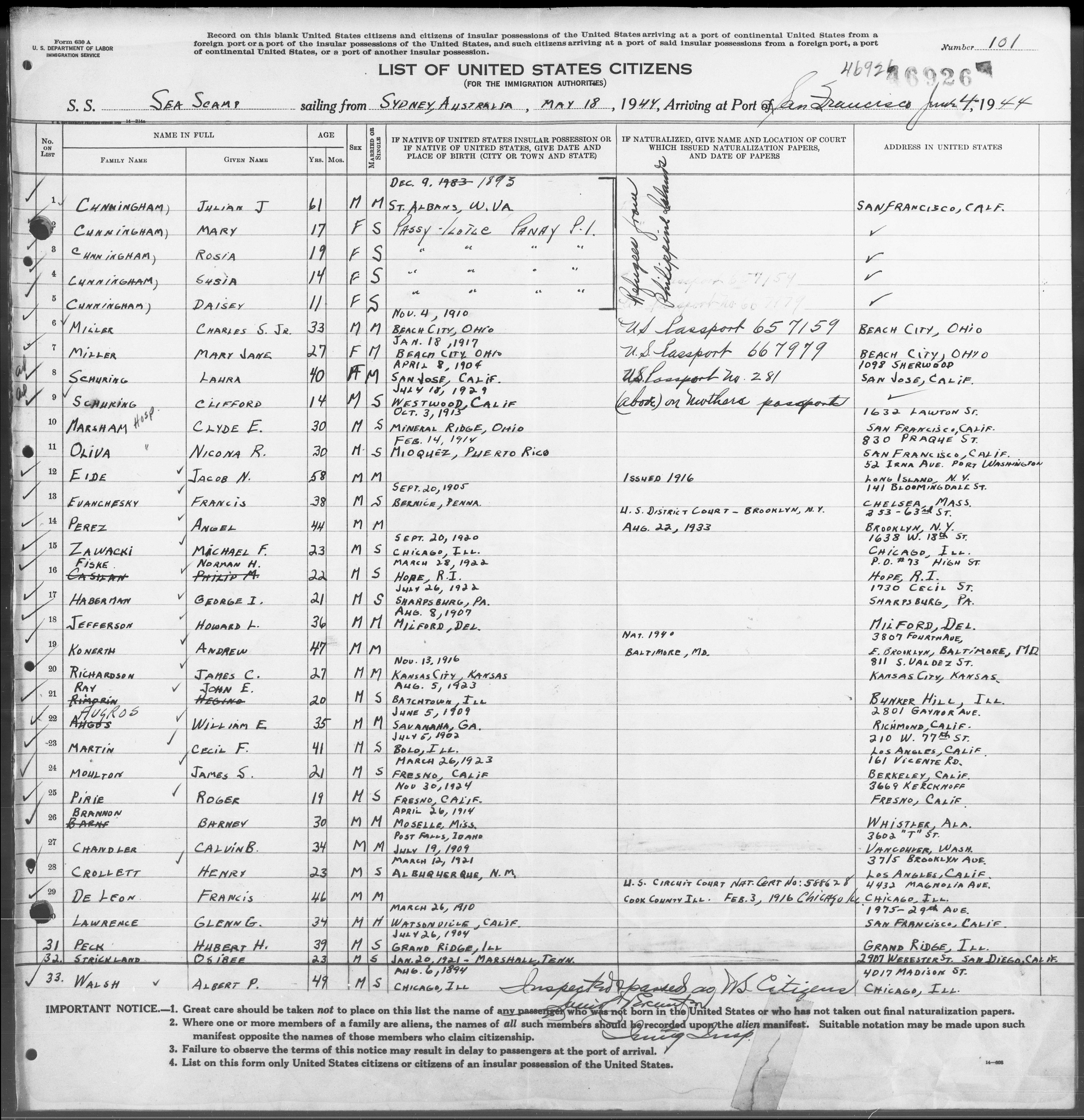
4. CUNNINGHAM, Julian (Father)
Veteran, S.A. 1904-1911
Male, Born Dec. 9 1883, St. Albans West Va. U.S.A.
American
(Julian Cunningham)
arrival1944may18
juliancunningham_vamasterindex
https://ancestors.familysearch.org/en/GB1D-TG9/julian-j-cunningham-1884-1980
5. CUNNINGHAM, Mary (Daughter)
Female, Born June 24 1927, Dumarao, Panay, P.I.
American
(Mary Cunningham)
arrival1944may18
6. CUNNINGHAM, Rosia (Daughter)
Female, Born June 22 1925, Dumarao Capiz Panay P.I.
American
(Rosia Cunningham)
arrival1944may18
7. CUNNINGHAM, Susia (Daughter)
Female, Born Aug. 24 1929, Dumarado (Dumarao?) Capiz Panay P.I.
American
(Susia Cunningham)
arrival1944may18
8. CUNNINGHAM, Dasiey (Daughter)
Female, Born April 11 1934, Dumarado (Dumarao?) Capiz Panay P.I.
American
(Dasiey Cunningham, Daisey Cunningham)
arrival1944may18
9. FERTIG, Claude E. (Husband & Father)
Major U.S. Army #0266 289 C.E., Commissioned April 19 1929
Male, Born July 20 1905, La Junta Colorado U.S.A.
(Claude E. Fertig, Claude Edward Fertig)
American Guerrillas in the Philippines
https://www.findagrave.com/memorial/36058522/claude_edward-fertig
10. FERTIG, Laverne Blanche (Wife & Mother)
Female, Born August 9 1908, Stoutland Missouri U.S.A.
American
(Laverne Blanche Fertig, Laverne Blanche Shockley Fertig)
arrival1944sep15
https://www.findagrave.com/memorial/3346182/laverne-blanche-fertig
11. FERTIG, Susan Beatrice (Daughter)
Female, Born Jan. 9 1944, Municipality of Tapas Capiz Panay P.I.
American
(Susan Beatrice Fertig)
arrival1944sep15
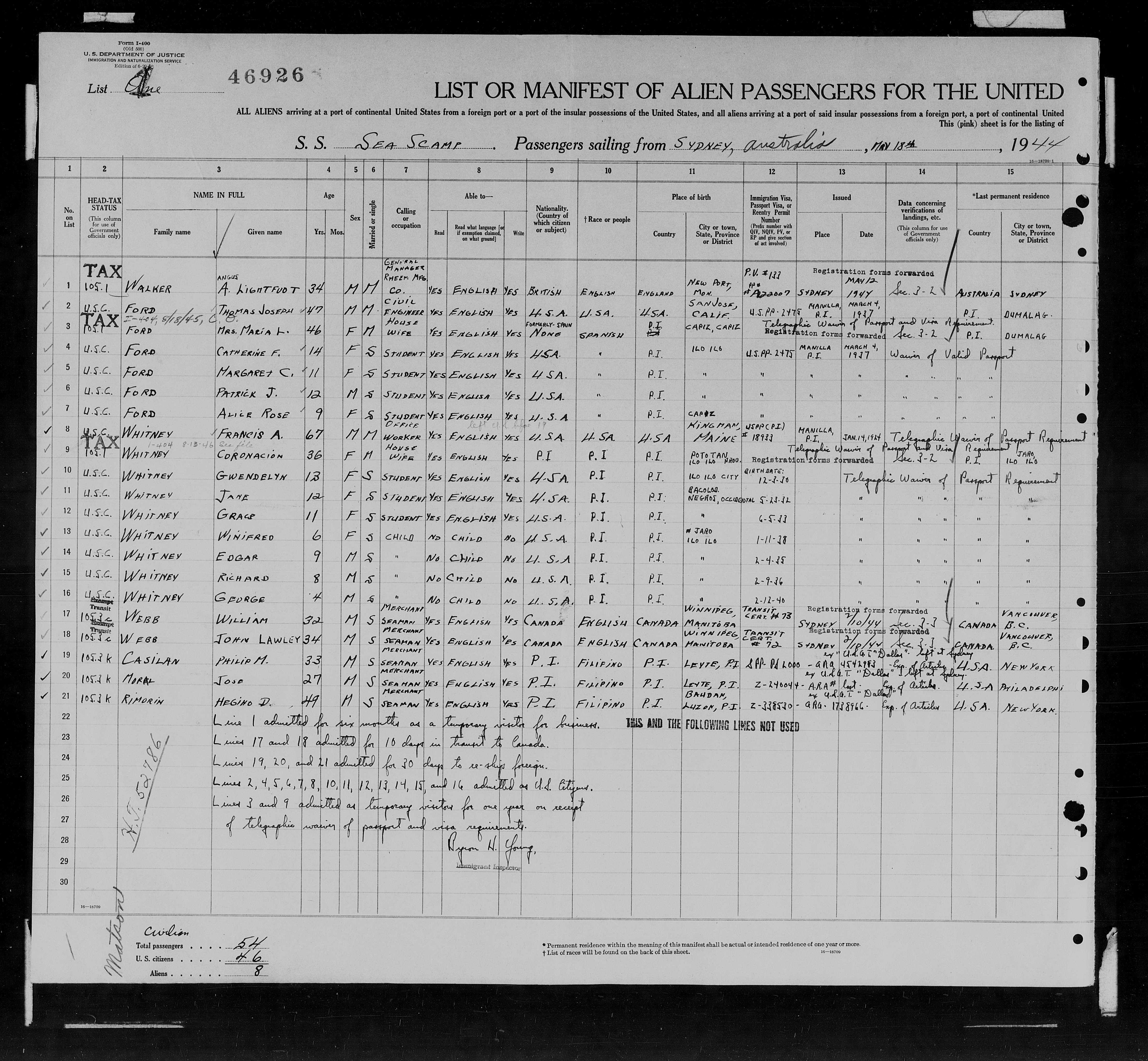
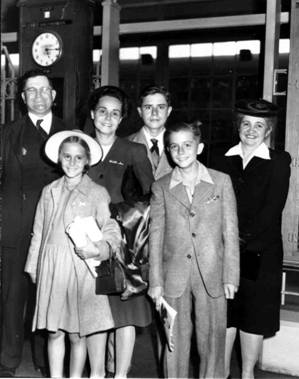 Ford families reunited in San Jose, California, in May 1945. Back row: Thomas J. Ford, Sr., Consuelo B. Ford, Henry A. Ford, Mrs. Thomas J. Ford. Front row: Consuelo and Stanley Ford. Consuelo B. Ford and her three children arrived in her husband’s home town after being liberated from Santo Tomas Internment Camp, Manila, Philippine Islands. Mr. and Mrs. Thomas J. Ford, Sr., and four of their seven children were rescued by a U.S. submarine from the island of Panay, Philippine Islands, after hiding in the mountains for two years. (Photo San Jose Mercury Herald) https://www.cnac.org/emilscott/ford01.htm 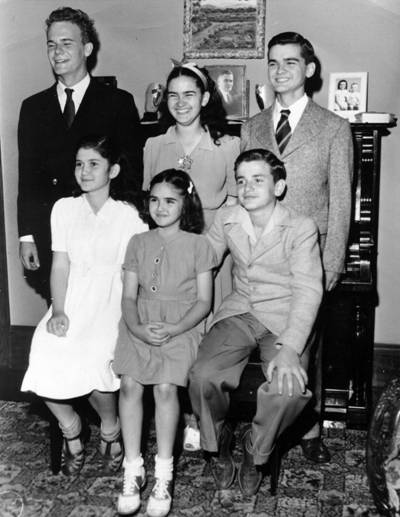 Ford cousins reunited in San Jose, California, in May 1945. Back row: Byron Ford, Jr., with his cousins Cathrine, Thomas, Jr., Front row: Margaret, Alice and Patrick Ford. Byron was liberated at Santo Tomas Internment Camp in Manila, Thomas was in hiding in Manila and his siblings were in hiding on the island of Panay and were rescued by a U.S. submarine. (Photo San Jose Mercury Herald) https://www.cnac.org/emilscott/ford01.htm |
Veteran, 2nd Lt. Field Art. 14th Field Art, Fort Sills Olka.
Male, Born March 30 1897, San Jose Cal. U.S.A.
American
(Thomas Joseph Ford)
arrival1944may18b
13. FORD, Maria L. (Wife & Mother)
Female, Born Aug. 19 1898, Capiz Panay P.I.
American (Spanish)
(Maria L. Ford)
arrival1944may18b
14. FORD, Catherine Francis (Daughter)
Female, Born May 4 1930, Iloilo City Panay P.I.
American
(Catherine Francis Ford, Catherine F. Ford)
arrival1944may18b
15. FORD, Margaret Concepcion (Daughter)
Female, Born April 29 1933, Iloilo City Panay P.I.
American
(Margaret Concepcion Ford, Margaret C. Ford)
arrival1944may18b
16. FORD, Patrick James (Son)
Male, Born April 30 1931, Iloilo City Panay P.I.
American
(Patrick James Ford, Patrick J. Ford)
arrival1944may18b
17. FORD, Alice Rose (Daughter)
Female, Born March 12 1935, Capiz Panay P.I.
American
(Alice Rose Ford, Alice Rose Ford)
arrival1944may18b
18. GREITEMANN, Rudolf Casper Petrus
Rev. Cath. Priest, Born March 28 1897, Groningen Netherlands
Dutch
(Rudolf Casper Petrus Greitemann)
19. HAWLEY, Maynard Clark
Captain U.S. Army, Q.M., Asst. Dist. Q.M., Asst. Dist Fin. 6th Military Dist., Panay P.I. #60035
Male, Born Nov. 9 1905, Omaha Nebr. U.S.A.
American
(Maynard Clark Hawley)
American Guerrillas in the Philippines
20. HEISE, Harry George (Husband & Father)
Veteran, 1899-1903 U.S. Army
Male, Born March 19 1880, Brooklyn N.Y. U.S.A.
American
(Harry George Heise)
arrival1944may11
https://www.findagrave.com/memorial/106562625/harry_g-heise
21. HEISE, Rosalia Concepcion (Wife & Mother)
Female, Born Sept. 4 1892, Naga Camarines Sur P.I.
Filipino
(Rosalia Concepcion Heise)
arrival1944may11
https://www.findagrave.com/memorial/106562626/rosalia-heise
22. HEISE, Gilbert "Sonny" (Son)
Male, Born June 12 1924, Iloilo City Panay P.I.
American
(Gilbert Heise, Sonny Heise)
arrival1944may11
23. HENDRIXSON, Holly (n) Jr.
Sarg. U.S. Army, Air Corps #14-00-2036
Male, Born May 4 1920, Madison Ark. U.S.A.
American
(Holly Hendrixson, Holly Hendrixson Jr.)
American Guerrillas in the Philippines
https://www.findagrave.com/memorial/70722399/holly-hendrixson
24. HODGES, Charles Newton
Veteran, Corp. Co. B 38th USV, Discharged May 23 1901
Male, Born Jan. 12 1881, Quinlan Texas U.S.A.
American
(Charles Newton Hodges)
arrival1944may11
https://www.findagrave.com/memorial/186274359/charles-newton-hodges
25. KING, Margaret (Mother)
Female, Born Feb. 10 1913, Noixykounsso Hungary
Registered permit to enter U.S.A.
Husband was Lt. A. W. King, U.S. Army, killed by Japs Dec. 1943
Has given up Hungarian Nationality
(Margaret King)
arrivalnodate
26. KING, Albert Guy Gilbert (Son)
Male, Born March 21 1940, Iloilo Panay P.I.
American
(Albert Guy Gilbert King)
arrivalnodate
27. LORING, Frederick Anthony
1st Lieut. U.S. Army, Engineer Q.M.
Male, Born Aug. 23 1910, Iloilo Panay P.I.
American
(Frederick Anthony Loring)
arrival1944may11
American Guerrillas in the Philippines
28. LUTHER, Martin Waldo
Pfc Sp. rate 1st, U.S. Army Air Corps, Enlisted Nov. 27 1940 #11-0-17-279
Male, Born July 18 1915, Salem N.H. U.S.A.
American
(Martin Waldo Luther, Martin W. Luther, Martin W. Luther Sr.)
American Guerrillas in the Philippines
https://www.findagrave.com/memorial/9262187/martin-w-luther
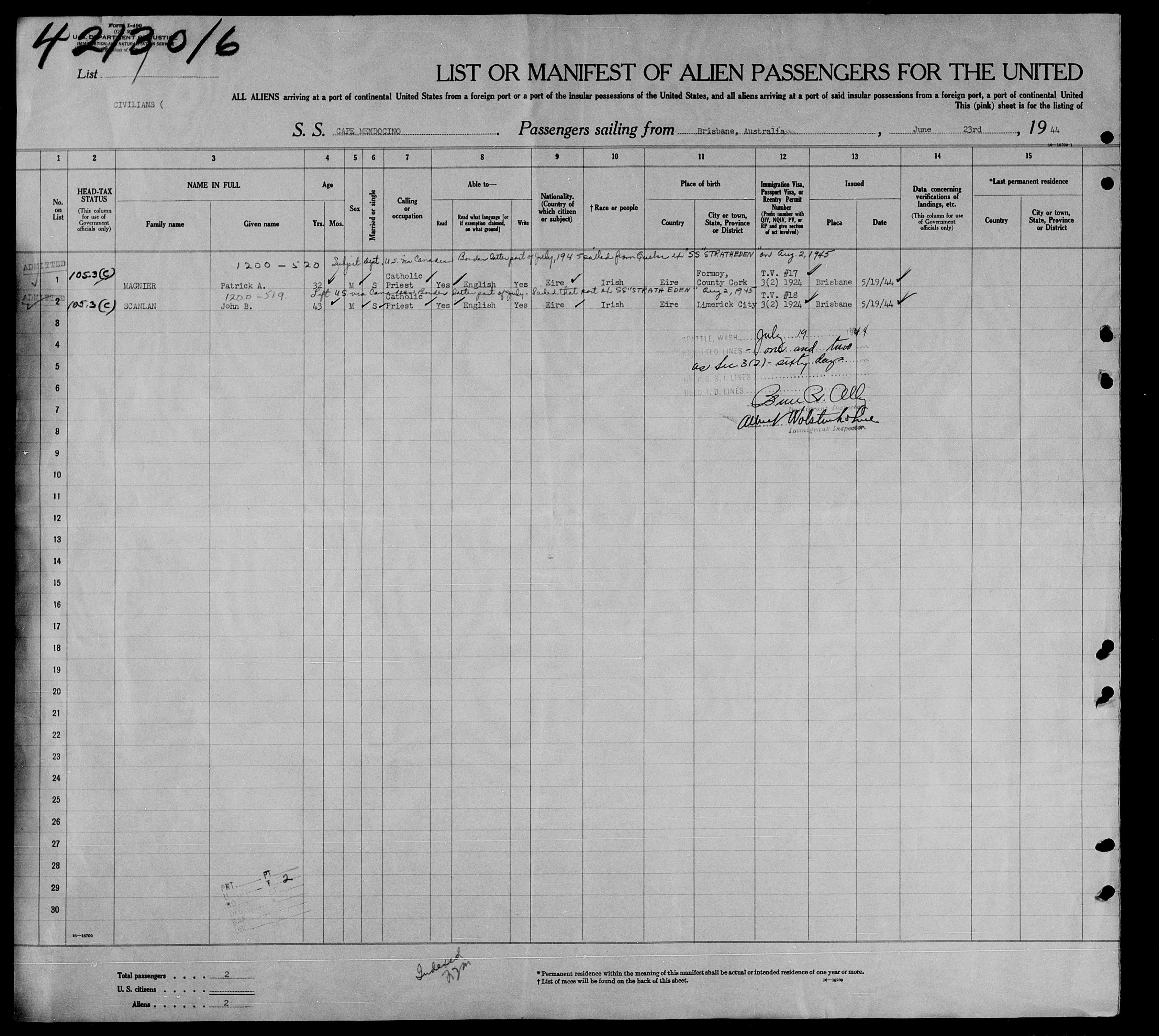
29. MAGNIER, Patrick Alphonsus
Rev. Cath. Priest, Born July 23 1911, Fermoy, County Cork, Ireland
Irish
(Patrick Alphonsus Magnier)
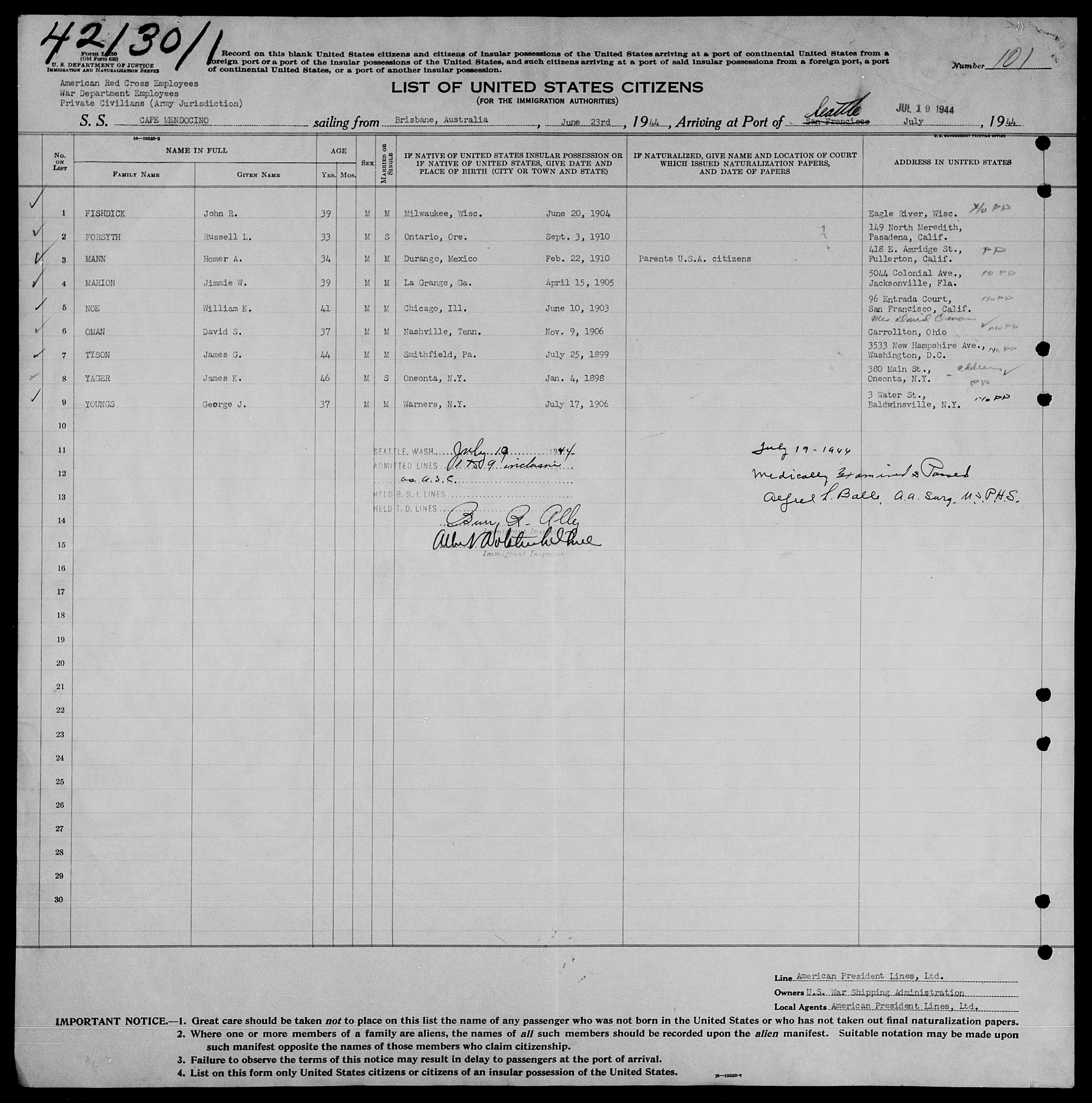
arrival1944jun23b
Missionary Escapes Fire in Submarine Fleeing Philippines
https://www.findagrave.com/memorial/142400764/patrick-alphonsus-magnier
30. MANN, Homer A.
1st Lt. C. E., Enlisted April 21st 1943 #60069
Male, Born Feb. 22 1910, Gomez Palacio, Durango, Mexico
American
(Homer A. Mann, Homer Alexander Mann)
arrival1944jun23
American Guerrillas in the Philippines
https://www.findagrave.com/memorial/36754844/homer-alexander-mann
31. MURPHY, Louis (n) (Father)
Veteran 1899 to 1905 U.S. Army Cavalry, Serg.
Male, Born Dec. 26 1878, Philadelphia Pa.
American
(Louis Murphy)
arrival1944may11
32. MURPHY, Jenny (Daughter)
Female, Born Oct. 27 1927 Iloilo City Panay P.I.
American
(Jenny Murphy)
arrival1944may11
33. SCANLAN, John Baptist
Rev. Cath. Priest, Born June 23 1901 Limerick City Ireland
British Passport
Irish
(John Baptist Scanlan)
arrival1944jun23b
34. SCHURING, Laura (Wife & Mother)
Female, Born April 8 1904 San Jose California U.S.A.
American
(Laura Schuring)
arrival1944may18
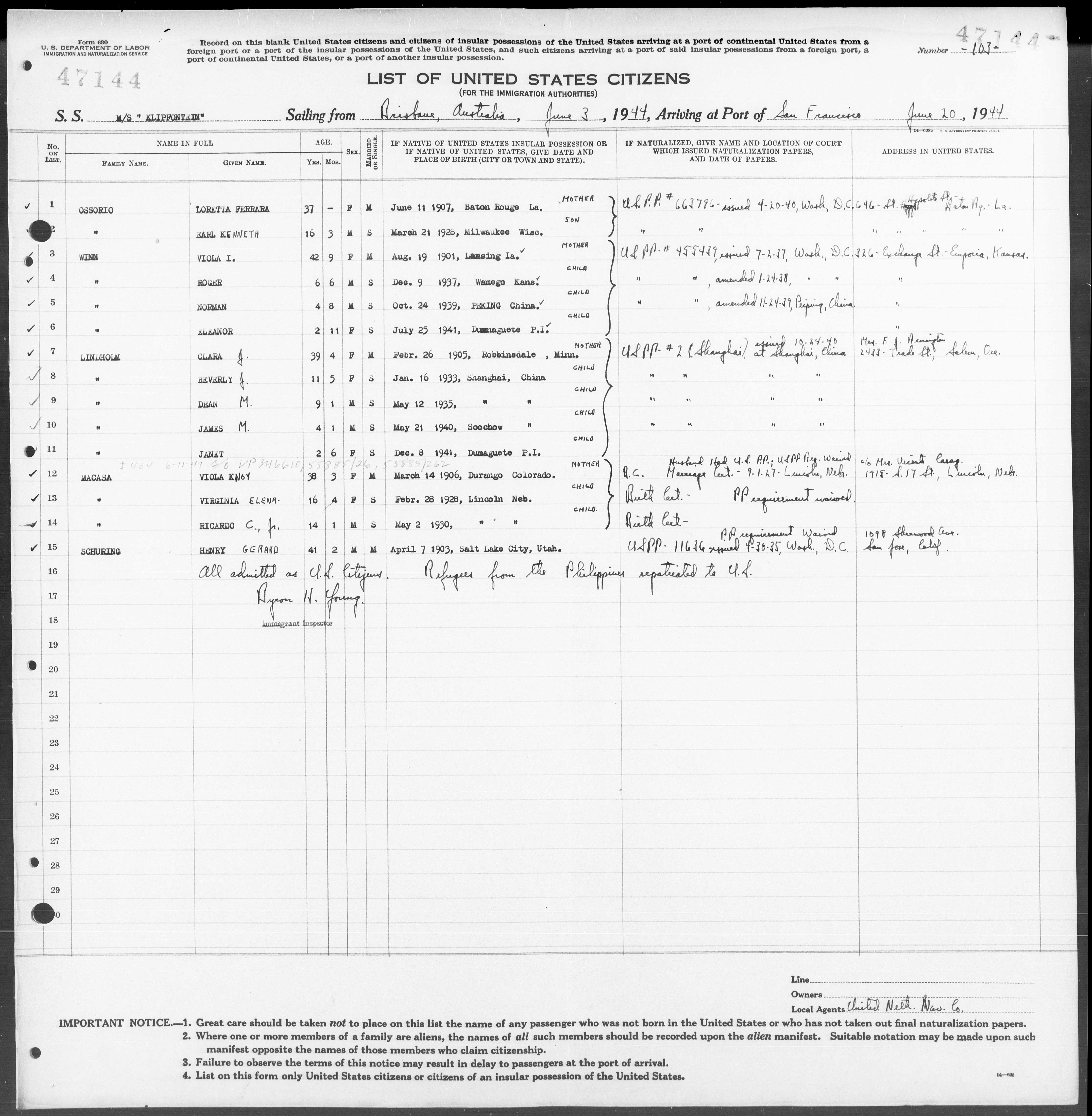
35. SCHURING, H. G. (Husband & Father)
Lieut. U.S. Army #60144, 6th M.D.
Male, Born April 7 1903 Salt Lake City Utah U.S.A.
American
(H. G. Schuring, Henry G. Schuring, Henry Gerard Schuring, also misspelled Henry G. Schurling)
arrival1944jun03
American Guerrillas in the Philippines
36. SCHURING, Clifford (Son)
Male, Born July 18 1929, Westwood California U.S.A.
American
(Clifford Schuring)
arrival1944may18
37. SEXTON, Arthur Roberson
Male, Born Oct. 29 1920, Bagio Louzon P.I.
American
(Arthur Roberson Sexton)
arrival1944may11
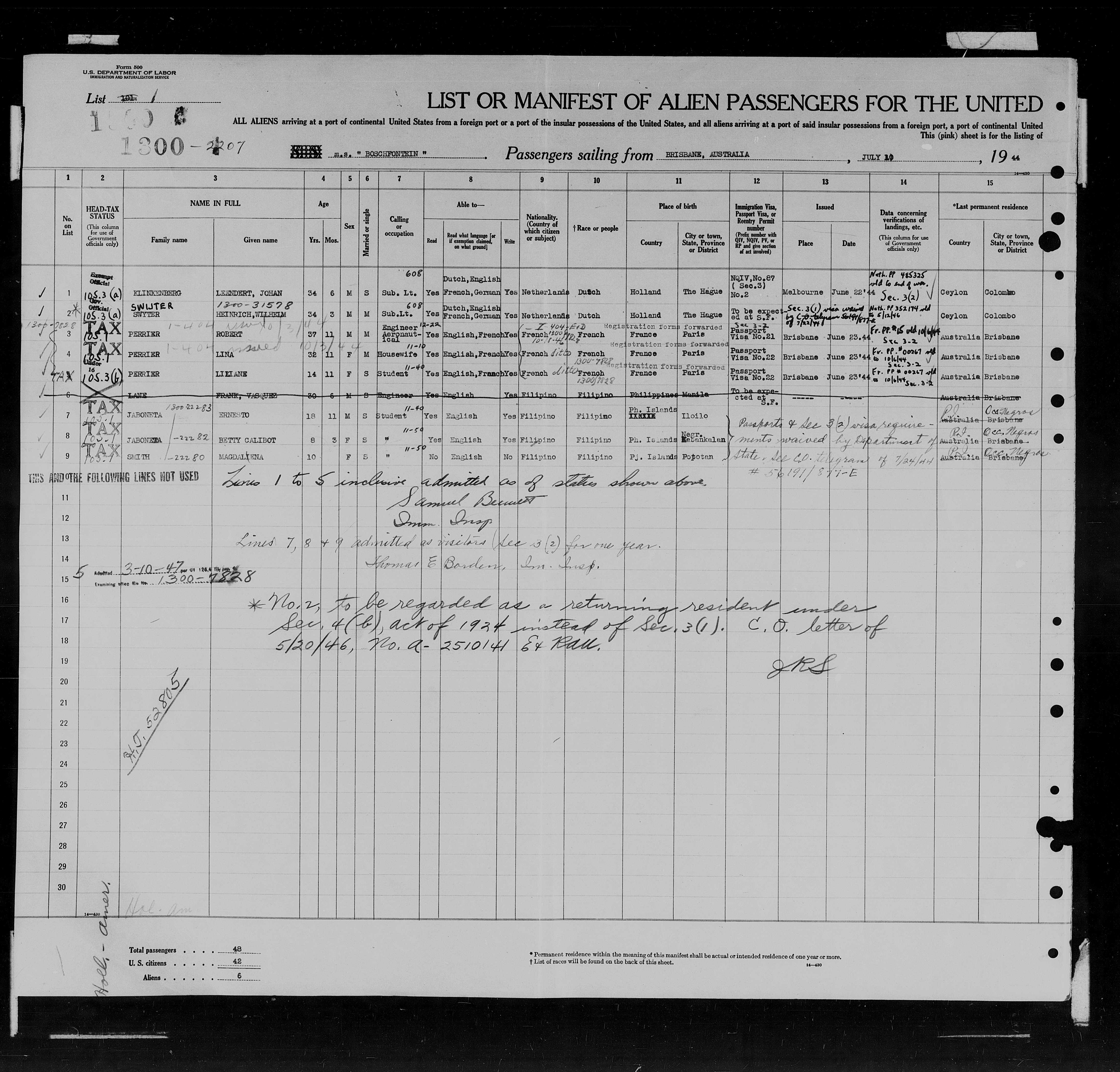
38. SMITH, William Edwards (Husband & Father)
Veteran, Jan. 10 1899 to Jan. 9 1902, Corp. 14th Cavalry U.S. Army
Male, Born East Henrettia N.Y. U.S.A.
(William Edwards Smith)
arrival1944jul10b
39. SMITH, Macaria (Wife & Mother)
Female, Born April 8 1895, Pulupando Negras Occ. P.I. (Pulupandan Negros Occidental?)
Filipino
(Macaria Smith, Macaria Molinda Smith)
arrival1944jul10b
40. SMITH, Geraldine (Daughter)
Female, Born Sept. 19 1926, Iloilo Panay P.I.
American
(Geraldine Smith)
arrival1944jul10c
41. SMITH, James (Son)
Male, Born Jan. 1 1928, Pototan Iloilo Panay P.I.
American
(James Smith)
arrival1944jul10c
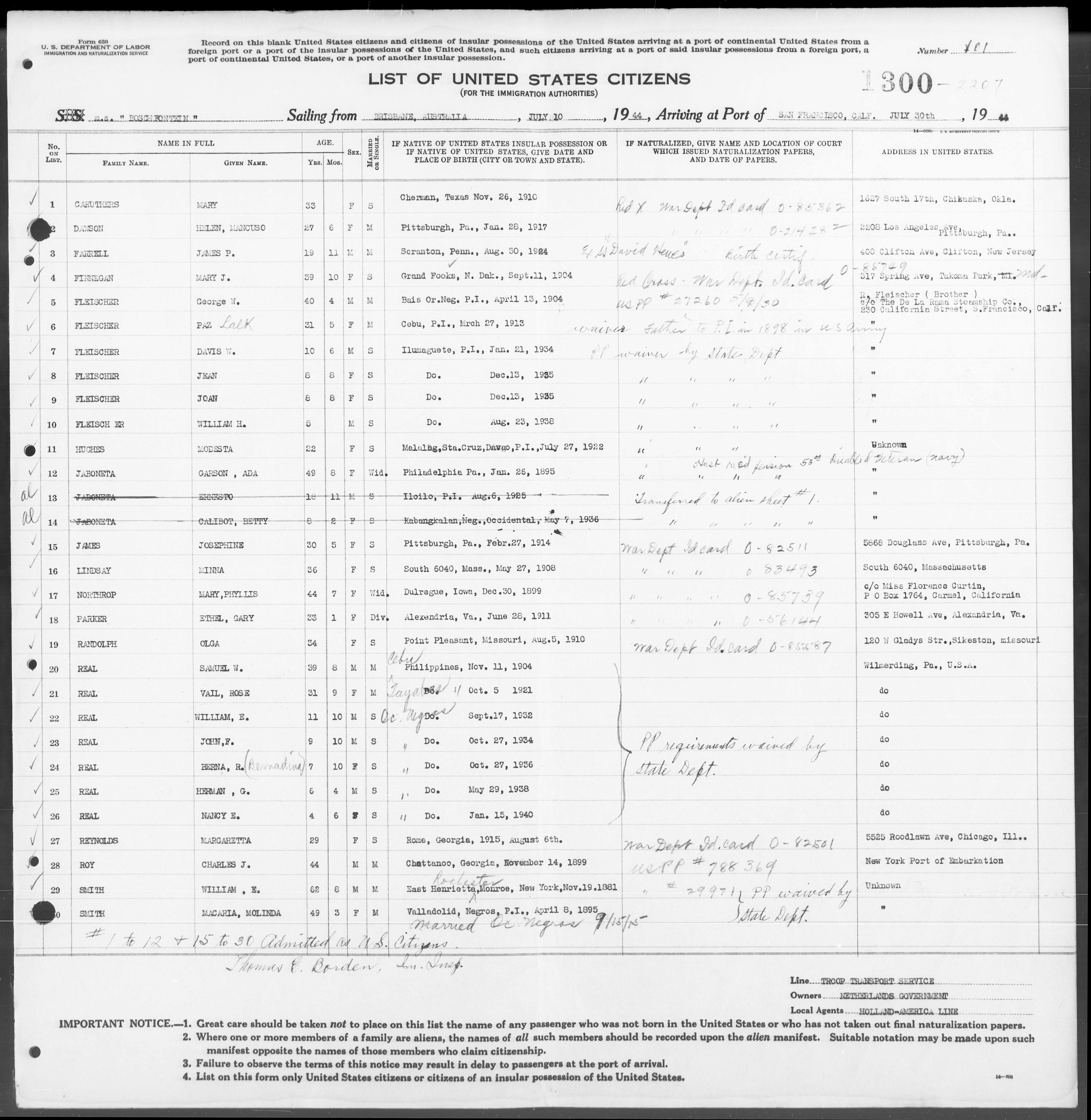
42. SMITH, Magdaliene Caspe (Daughter)
Female, Born 1934
Adopted child
Filipino
(Magdaliene Caspe Smith, Magdaline Smith)
arrival1944jul10
arrival1944jul10c
43. SPENCER, Cyril L. (Husband)
Captain U.S. Army #60032 6th M.D., C.E., Sept. 43 Sara Iloilo
Executive Officer, Chief Mapping Section, Dist Engineers VI M.D.
Male, Born May 6 1905, Morrice Michigan U.S.A.
American
(Cyril L. Spencer, Cyril Luther Spencer Jr.)
arrivalnodate
American Guerrillas in the Philippines
https://www.findagrave.com/memorial/212850004/cyril-luther-spencer
44. SPENCER, Louise Beatrice Mortimore (Wife)
Female, Born March 6 1912, Westmaint Canada
Canadian
(Louise Beatrice Mortimore Spencer, Louise Spencer, Beatrice Louise Reid Spencer, Louise Reid Spencer)
arrivalnodate
https://www.findagrave.com/memorial/224841570/beatrice_louise-spencer
Evacuation by Submarine: USS Angler in the Philippines, 20 March 1944
https://www.history.navy.mil/browse-by-topic/wars-conflicts-and-operations/world-war-ii/1944/angler-philippines-evac.html
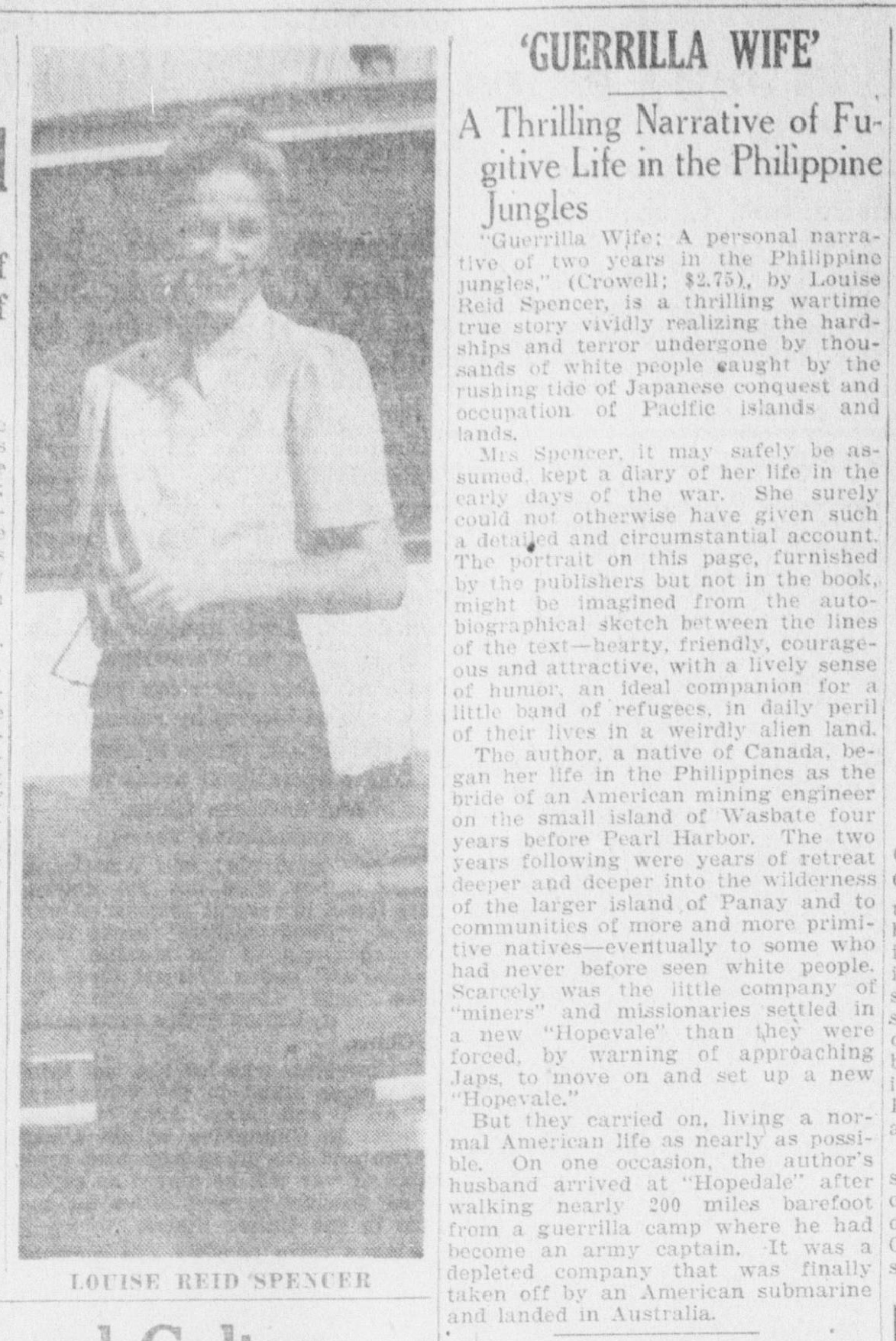
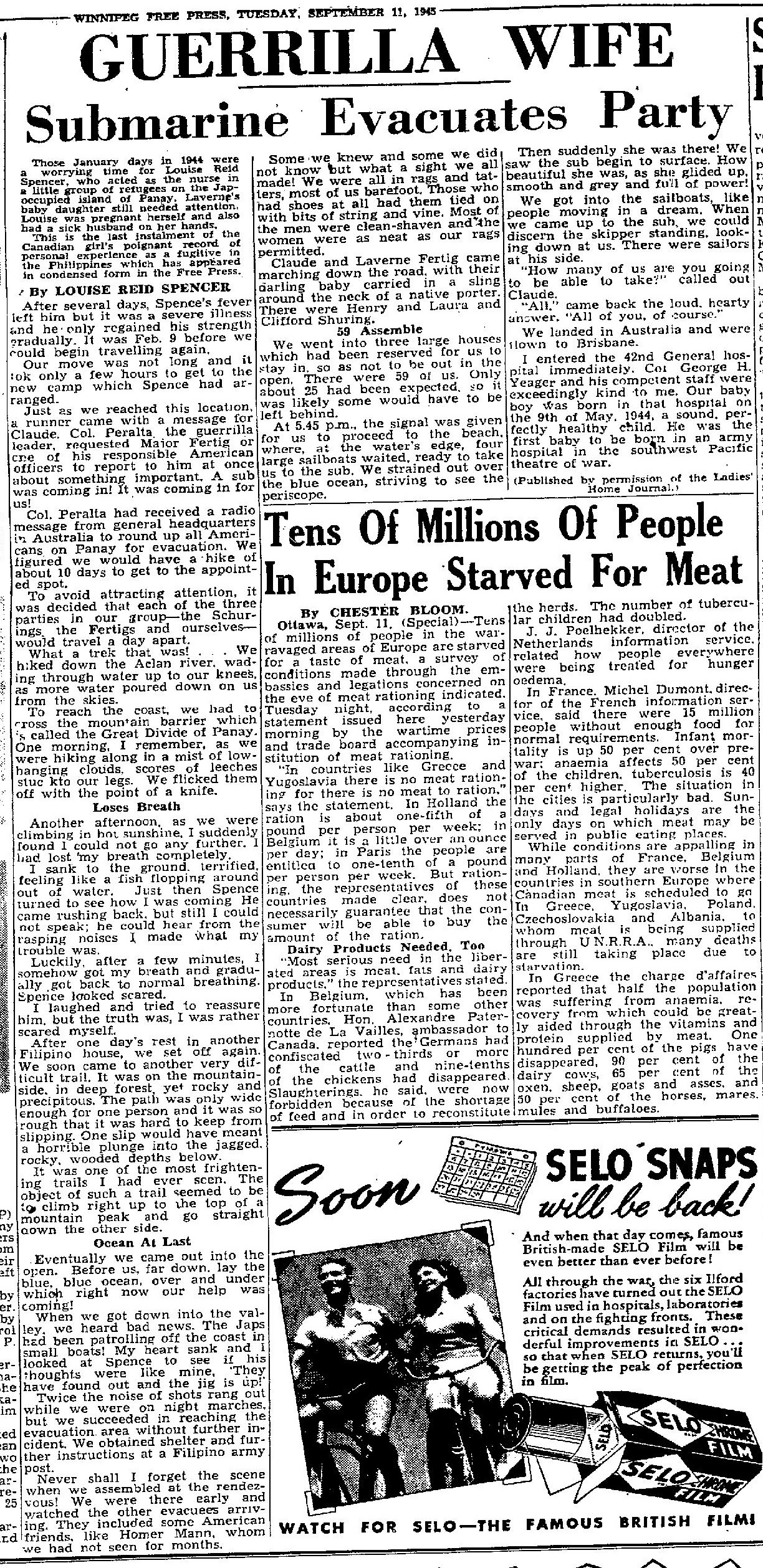
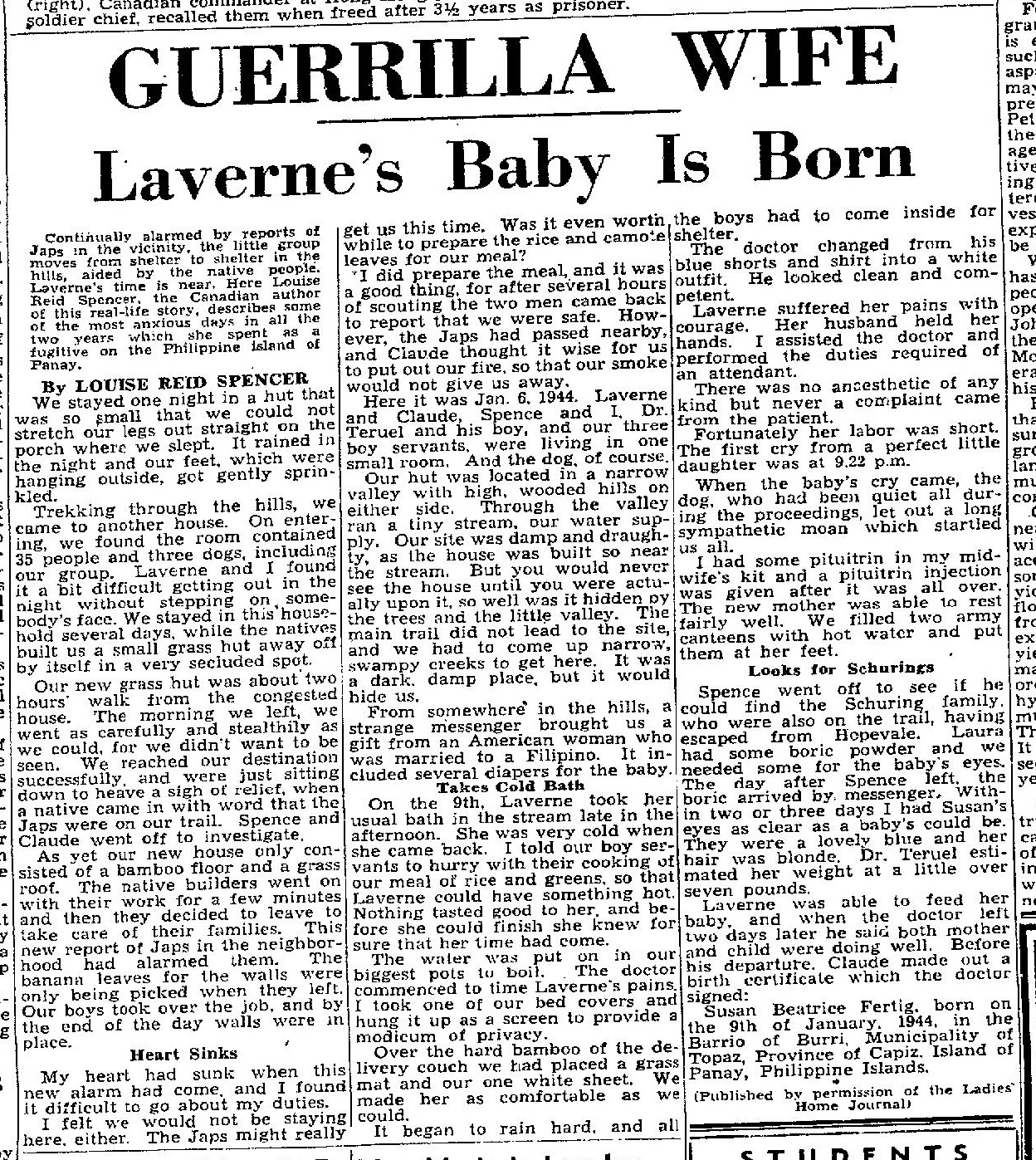
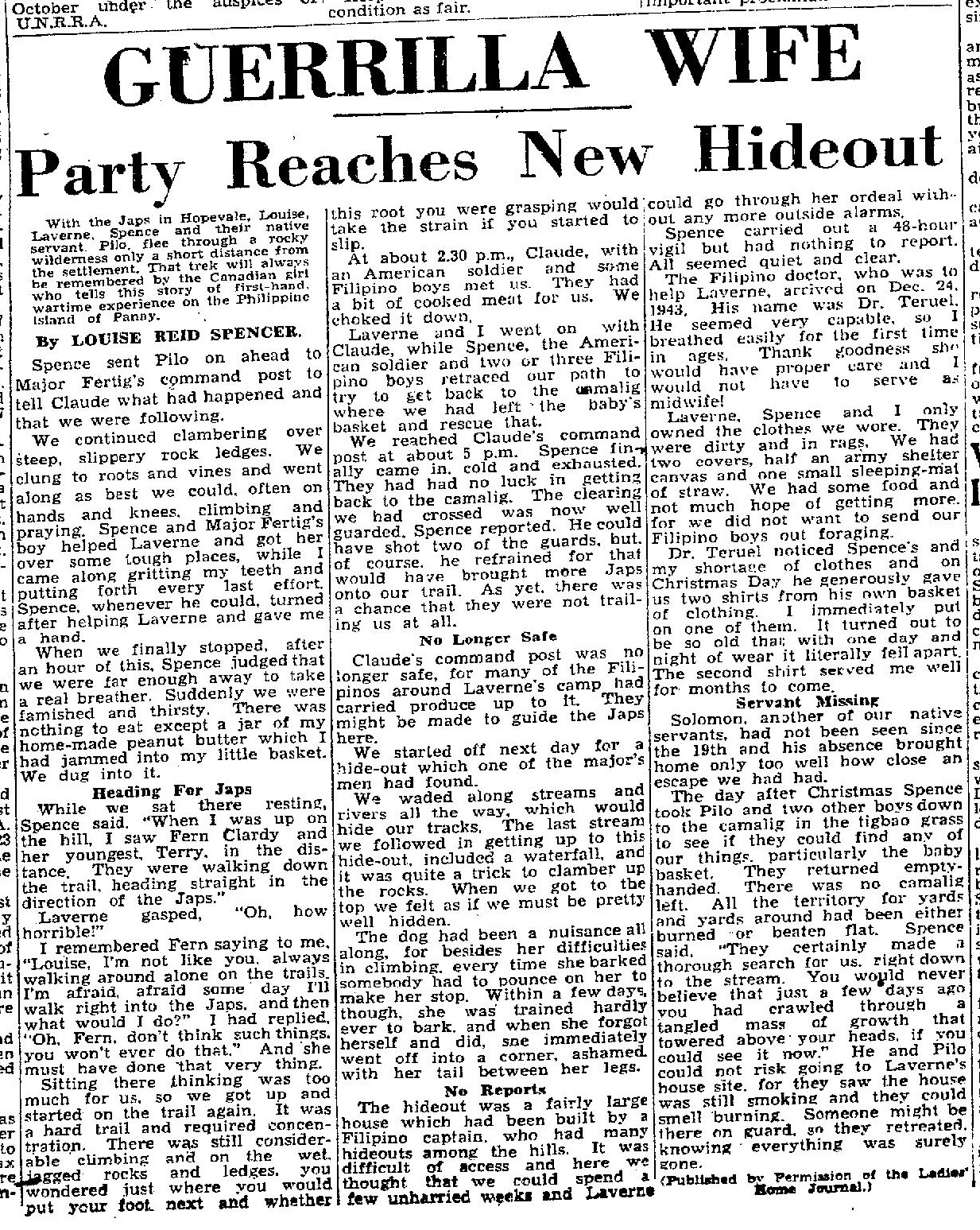
ANGLER to the Rescue!
https://ussnautilus.org/angler-to-the-rescue/
45. TIAPON, Birdie Margaret (Mother)
Female, Born Feb. 27 1902, Chicago Ill. U.S.A.
American
Husband (Oton) Farmer, killed Nov. 1942
(Birdie Margaret Tiapon, Birdie Margaret Jeffrey Tiapon)
arrival1944may11
https://www.findagrave.com/memorial/177456604/birdie-margaret-tiapon
46. TIAPON, Macaria Jeffery (Daughter)
Female, Born June 7 1927, Chicago Ill. U.S.A.
American
(Macaria Jeffery Tiapon)
arrival1944may11
47. TIAPON, Marjorie Louise (Daughter)
Female, Born Aug. 17 1931, San Francisco Cal. U.S.A.
American
(Marjorie Louise Tiapon)
arrival1944may11
48. TIAPON, Serafin Benjamine (Son)
Male, Born May 1 1933, San Mateo Cal. U.S.A.
American
(Serafin Benjamine Tiapon)
arrival1944may11
49. TIAPON, Earl Epifanio (Son)
Male, Born June 24 1941, Oton Iloilo P.I.
American
(Earl Epifanio Tiapon)
arrival1944may11
50. WHITNEY, Francis A. (Husband & Father)
Veteran U.S.M.C. 1898 to 1903, Corp. also Naval Service on Guam 1903
Male, Born Feb. 7 1877, Kingman Maine
American
(Francis A. Whitney, Francis Amasa Whitney)
arrival1944may18b
https://www.findagrave.com/memorial/142293259/francis-amasa-whitney
51. WHITNEY, Coronacion (Wife & Mother)
Female, Born Dec. 12 1907, Pototan Iloilo P.I.
Filipino
(Coronacion Whitney)
arrival1944may18b
52. WHITNEY, Gwendolyn (Daughter)
Female, Born Dec. 3 1930, Iloilo City Panay P.I.
American
(Gwendolyn Whitney)
arrival1944may18b
53. WHITNEY, Jane (Daughter)
Female, Born May 23 1932, Bacolod Negros P.I.
American
(Jane Whitney)
arrival1944may18b
54. WHITNEY, Grace (Daughter)
Female, Born June 5 1933, Bacolod Negros P.I.
Americn
(Grace Whitney)
arrival1944may18b
55. WHITNEY, Edgar (Son)
Male, Born Feb. 4 1935, Jaro Iloilo Panay P.I.
American
(Edgar Whitney)
arrival1944may18b
56. WHITNEY, Richard (Son)
Male, Born Feb. 9 1936, Jaro Iloilo Panay P.I.
American
(Richard Whitney)
arrival1944may18b
57. WHITNEY, Winfred (Daughter)
Female, Born Jan. 11 1938, Jaro Iloilo Panay P.I.
American
(Winfred Whitney)
arrival1944may18b
58. WHITNEY, George (Son)
Male, Born Feb. 12 1940, Jaro Iloilo Panay P.I.
American
(George Whitney)
arrival1944may18b

|
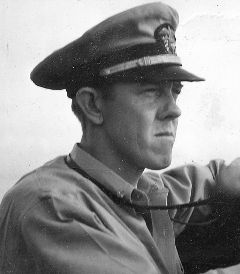
ROBERT IRVING OLSEN
USNA 1933 Born 4 Jan 1910 Waukegan, Illinois, USA Died Sep 1985 (75) Warship Commands listed for Robert Irving Olsen, USN Ship Rank Type From To USS Angler (240), T/Lt.Cdr., Submarine, 1 Oct 1943 to 9 Jun 1944 15 Feb 1944 USS Angler (Lt.Cdr. R.I. Olsen) departed from Midway for her 2nd war patrol. She was ordered to patrol in the South China and Sulu Sea. 20 Mar 1944 USS Angler (Lt.Cdr. R.I. Olsen) evacuates 58 people, including women and children, from the west coast of Panay, Philippines. 9 Apr 1944 USS Angler (Lt.Cdr. R.I. Olsen) ended her 2nd war patrol at Fremantle, Australia. https://uboat.net/allies/commanders/3419.html |
|
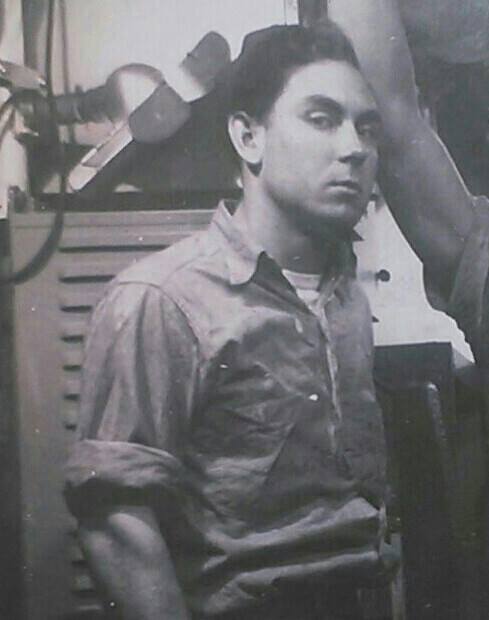
ERNEST FULGHAM
Ernest Fulgham (my father) U.S. Navy World War 2 USS Angler (submarine) Picture taken aboard the Angler around 1944 in the Pacific Ocean. My father was around 19 years old in the photo. He was aboard the Angler when it carried out a famous rescue mission of U.S. civilians on the island of Panay, Philippines. My father died in 1972 when I was only 4 years old. He's buried in Waycross, Georgia. My mother passed down his memories of the rescue mission to me. It was a secret mission ordered by General MacArthur who had received intelligence from allied Philippine resistance fighters indicating the Japanese were killing civilians. The U.S. Navy had been secretly providing assistance to the Philippine fighters via nighttime rendezvous with subs. - Jeff Fulgham x (twitter) |
|
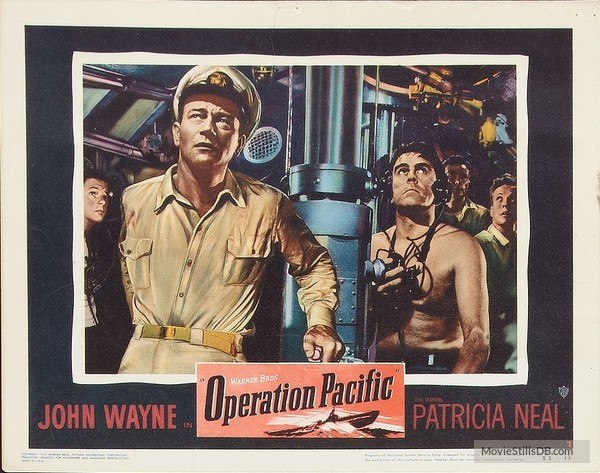
The rescue mission was later portrayed in the 1951 Hollywood film Operation Pacific staring John Wayne. The image on the right is of one of the movie posters showing John Wayne and a young actor. The young actor to the right of John Wayne in the movie poster looks eerily similar to my dad, who was 19 in the photo. You can read more online at http://ussnautilus.org/blog/angler-to-the-rescue/ - Jeff Fulgham x (twitter) |
|
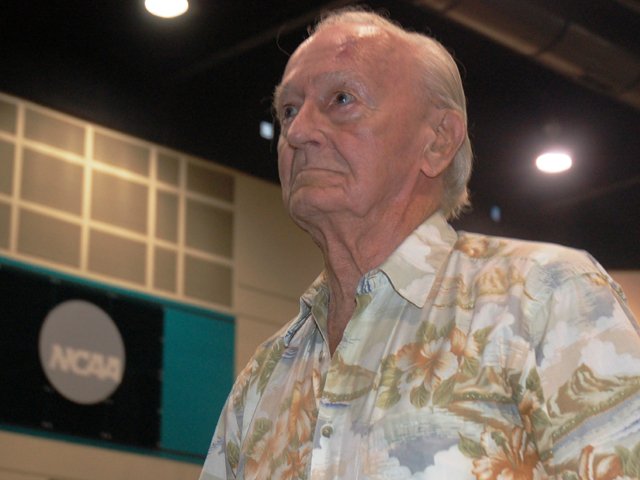 ROBERT GERMAN
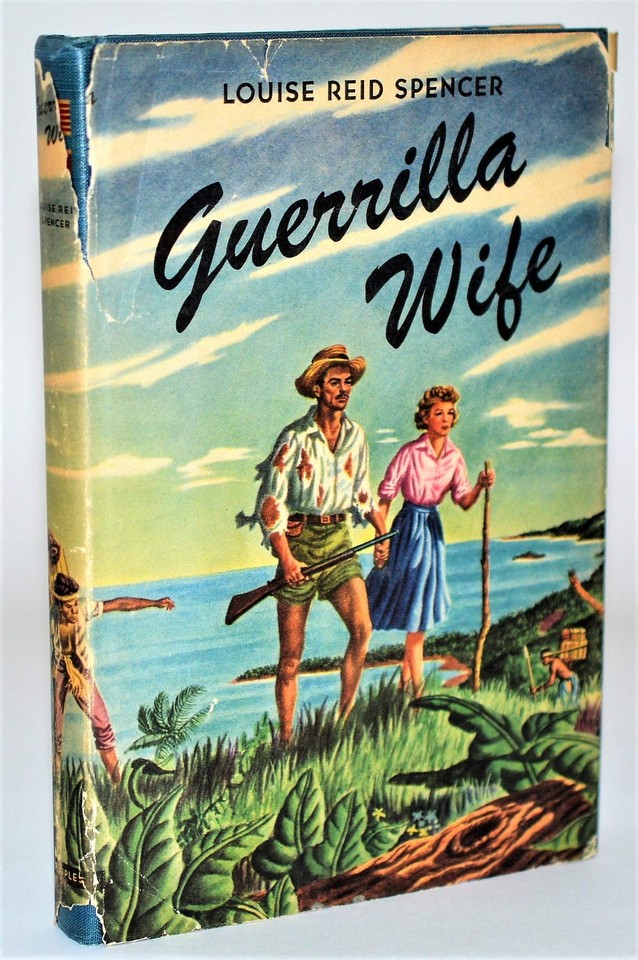
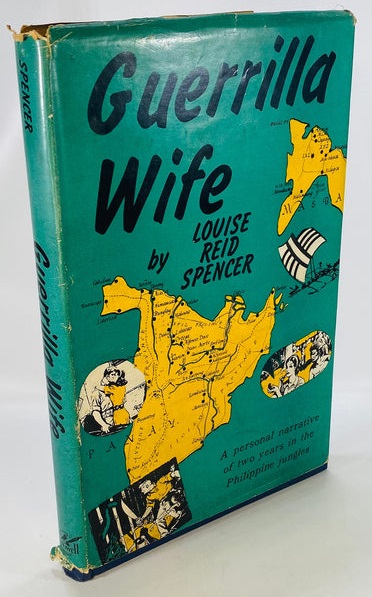
A hero among us by Walter Allread (SC Life Features July 3, 2013) Robert German When WWII veterans were asked to stand to be recognized at Horry Electric Cooperative's Annual Meeting May 14, only Robert German rose—and HEC members promptly followed suit, giving him a standing ovation. Serving on two submarines in World War II in the South Pacific that combined to sink 34 Japanese ships, retired First Class Petty Officer Robert “Bob” German has plenty of stories about successful combat action at sea. Those aren’t the ones he likes to tell the best, not because they’re too graphic, or painful, but because two others, two rescue missions, stand out in his memory above all else for their raw emotional power. (Note: The rescue of 58 people from Panay Island, and the rescue of the pregnant American woman from Panay Island, were not two separate missions, but refer to the same submarine rescue mission conducted by U.S.S. Angler on March 20, 1944 in Panay Island) ‘10 to 12’ passengers The first came on just the second patrol for German, an Horry Electric Cooperative member in Murrells Inlet. A call came in for a rescue mission for a group of “10 to 12” Americans who had been hiding from and being harassed by the Japanese Army on the island of Panay. His boat, the USS Angler, responded. “Instead of 12, it turned out to be 57 people,” says German, who turns 89 this month. “The sub carried a full crew of 77. “We got everyone aboard, putting all the women and children at one end in the forward torpedo room, and the men and boys in the aft quarters with the crew amidships for eight days and nights, and we ran out of food two days before we got them safely back to Darwin, Australia.” ‘You rescued me’ The second story involved the rescue from the Japanese-occupied Philippines of an American woman who was seven months pregnant and carrying pages of hand-written notes about how for two-and-a-half years she’d been running from the Japanese, hiding in caverns and caves until she could escape. “We came into some action and it got real loud, and I remember thinking, there’s nothing in the submarine manual about delivering a baby,” German says, joking. “But we also safely delivered her to Australia.” Fast forward after the war, and thanks to the G.I. Bill, German received his degree in industrial engineering from the University of Maryland, where his wife and baby boy were staying with him. After class he went to pick up his son from being cared for at a converted barracks facility on campus, and greeting him at the door was a young Filipino woman. “I smiled warmly at her and asked her where she was from, and she said ‘Panay,’” says German, who also served on the USS Bluefish. “I got chills. I told her that during the war I’d served on a submarine that rescued people off Panay, and she said, ‘Sir, I saw your boat surface. You rescued me.’ I was absolutely floored. “She then went in and brought me a book to look at, and it was the story of the pregnant woman we’d also rescued that had been published as an autobiography, and the last chapter was about our rescuing her. You talk about a small world.” https://scliving.coop/sc-life/sc-life-features/a-hero-among-us/
|
Robert German (1924–2023)
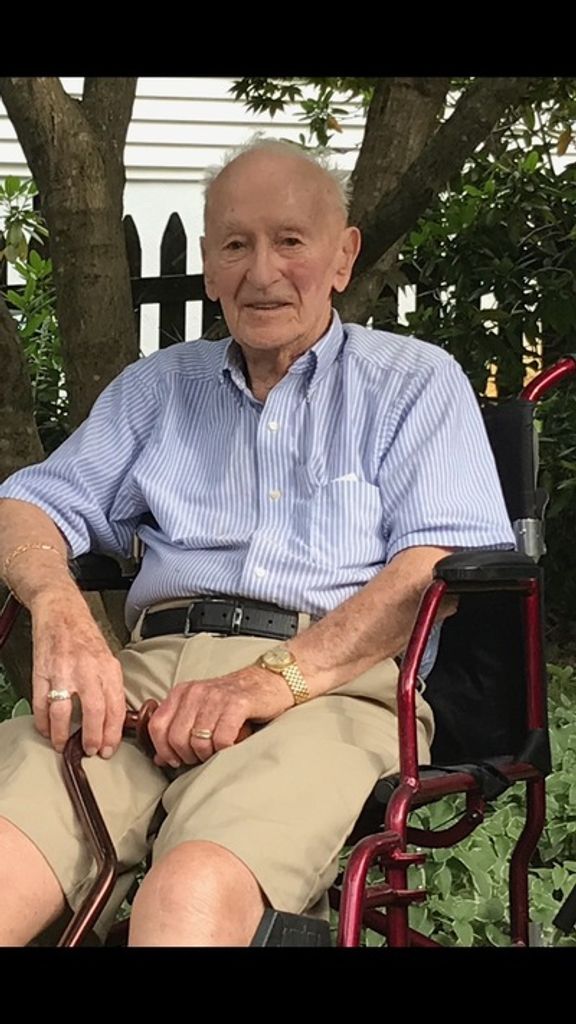 Robert "Bob" German died in Murrell's Inlet, SC following a brief illness. He was born in Baltimore, MD, the only child of Elva and Lee German. Bob dropped out of high school in 1939 to apprentice as a tool and die maker. Following the attack on Pearl Harbor, he enlisted in the US Navy and served aboard two submarines as a Machinist's Mate Second Class. He completed three war patrols in the Pacific Theater, two aboard the USS Angler and one aboard the USS Bluefish. Bob's boats saw extensive combat action, but he was most proud of two missions that rescued a total of 58 American and Filipino civilians from Japanese hostiles on the island of Panay (Note: The rescue of 58 people from Panay Island, and the rescue of the pregnant American woman from Panay Island, were not two separate missions, but refer to the same submarine rescue mission conducted by U.S.S. Angler on March 20, 1944 in Panay Island).
Bob attended the University of Maryland on the GI Bill and earned a BS in Mechanical Engineering. He then served as an officer in the Central Intelligence Agency (CIA) for nine years before going on to work for the American Bank Note Company for forty years. He was eventually promoted to a vice president position and retired in 2001. In the early 1970s, Bob purchased raw land and developed the Arbomar, a high-rise, Gulf-front condominium on Long Boat Key, Florida.
Bob was also a prolific world traveler, highly skilled carpenter, Freemason, and Shriner. He donated generously to the arts and higher education. Bob married Arleen Myshrall in Hartford, Connecticut in 1943. The couple had three children before divorcing in 1976. Bob's second wife Edna Morrow died in 1983. He married Ruth Cope Robinette in 1997.
Bob was preceded in death by daughter Barbara in 2015 and son Bob in 2020. In late 2020, a granddaughter's DNA test revealed that Bob had fathered a daughter while stationed in Australia during the war. This discovery brought him great happiness in his final years. He was united with his daughter and her two children in Annapolis, MD last July.
Bob is survived by his wife Ruth, son Mark (wife Mary) of Annapolis, MD, daughter Dorothy Smith of Kalamunda, Australia, six grandchildren, ten great grandchildren, two great great grandchildren and numerous friends and extended family.
https://www.grandstrandcremation.com/obituary/robert-german
https://www.legacy.com/obituaries/name/robert-german-obituary?pid=204633181
Water, Water, Everywhere–But Don’t Drink It!
In the midst of her second patrol, in February of 1944, ANGLER was dispatched to Panay, an island in the Philippines, to evacuate civilians in advance of a Japanese invasion. The crew was told to expect about 20 refugees; in reality, there were 58. The trip back to Australia was long and the quarters cramped, but the worst part came towards the end of the trip when, the commanding officer wrote in the “Health, Food, and Habitability” section, “our fresh water became contaminated (cause still unknown) which caused numerous cases of severe nausea. During the last week of the patrol this nausea was so pronounced that 1/3 officers and crew could not hold food in their stomachs.” When the boat arrived in Fremantle on 9 April, he requested that the fresh water tanks be thoroughly cleaned.
https://ussnautilus.org/652-2/
Evacuation by Submarine: USS Angler in the Philippines
history.navy.mil
Adam Bisno, Ph.D., NHHC Communication and Outreach Division, March 2019
20 March 1944
Around 9:45 a.m. on 20 March 1944, on the north side of Panay, in the Philippines, a small party of refugees arrived at the edge of the woods and peered out onto the beach. One of the party was Louise Spencer, nearly eight months pregnant and who had been hiding from the Japanese for the previous two years. In rags and tennis shoes, she took stock of a scene she would recount in her memoir Guerrilla Wife, which came out the following year.[1] The memoir and the U.S. Navy documents that confirm many of its details provide an invaluable means of reconstructing the story of how the Gato-class submarine Angler (SS-240) came to the rescue of Louise Spencer and 57 other people in desperate need of a way out of the Philippines.
Soon Spencer and her party spotted a few more refugees in the woods near the beach, then a dozen, then a score, then more. Everyone strained to see evidence of the submarine — a periscope, perhaps, or a shadow in the water.[2]
Their hopes high, the evacuees made their way to small houses on the beach, where they would remain out of sight until the appointed time. Little did Spencer and the others know, but Angler was only a mile away, just under the surface. Its crew had already observed the “large crowd of people walking behind the tree line on the beach,” according to the commanding officer’s report.[3]
The evacuees came outside again at about 5:45 p.m. Fifteen minutes later, Spencer caught sight of Angler, which rose from the water only 1,000 yards away.[4] Spencer and the others boarded small sailboats, which took them to the sub. By 7:10, all had descended into the relative safety of Angler’s decks.[5]
The chief petty officers’ cabin accommodated the female passengers in greatest medical need. That included Spencer, the only pregnant woman aboard; four other women; a boy of three; a baby of 11 weeks; and a 13-year-old girl named Gwendolyn Whitney. Spencer describes her as having been “at death’s door…, in a sort of delirium, with a high fever.” The pharmacist’s report confirms these details.[6]
Gwendolyn Whitney’s experience of the preceding several weeks was typical of many of the refugees aboard Angler. She had been on the run with her Filipina mother, American father, and five younger siblings. All had made it to Angler, where one of them recounted Gwendolyn’s recent misfortunes to a member of the crew.
On 21 February 1944, the Whitney family had received word that a Japanese killing squad was on its way, so they hid in the nearest bamboo thicket. That very night, Japanese soldiers found the camp and murdered Gwendolyn’s great-grandmother. Narrowly escaping gunfire, the rest of the family fled to the mountains, but Gwendolyn, in a state of shock and already feverish, only got sicker. By 27 February, as the Whitneys began their journey on foot to Angler, Gwendolyn had to be carried in a hammock. At one point, they found treatment for her at a field hospital but to no avail. On the move again, her fever rose. It continued to rise, even on Angler, to 104 degrees by the second day of the voyage.[7]
Trapped on Panay
The Whitneys, the Spencers, and the rest of the American expatriate community were trapped on Panay after it fell to the Japanese on 20 April 1942. Their choices were to stay put — and face imprisonment, brutalization, execution, or some combination the three — or to head for the hills of central Panay.
Panay, a 4,448-square-mile, triangle-shaped island, is the Philippines’ sixth largest. The island’s central valley stretches about 95 miles from the city of Capiz, on the north coast, to the city of Iloilo, in the south. East and west of the valley rise several series of hills and mountains, the highest reaching 6,726 feet.[8] It was to these hills and mountains that American and Filipino soldiers and civilians fled after the Japanese conquest of Panay.
There, in central Panay, Americans already in the U.S. Army sprung to action as advisers and liaisons among rival guerrilla groups.[9] In some cases, Americans not yet enlisted managed effectively to join the U.S. Army remotely. Homer Mann, who would be with the Spencers throughout the ordeal, joined on 21 April 1943. Carlos Fernandez Antikoll enlisted on 6 August 1943, and so did Louise Spencer’s husband Cyril the following month. Several more U.S. Army men served with the guerrillas, too, and survived to give account of themselves aboard Angler in March 1944.[10]
Secret Landings
General Douglas MacArthur was aware of these American guerrillas as early as May 1942. A naval intelligence report composed shortly after the war recounts his decision to “test the feasibility of making landings by submarine [in order to] supply small communication and coast watcher units in the Philippines.” Throughout the Philippines, the United States counted on 120 secret radio stations, which helped with the coordination of transports and the transmission of important information. In this way, American guerrillas kept in regular contact with MacArthur, now the Supreme Commander of Allied Forces in the Southwest Pacific Area.[11] The Spencers and their party relied on such news, arrivals, and supplies in order to survive and, ultimately, in order to escape.
The first of these submarine missions occurred in January 1943 at Negros island, just across the Guimaras Strait from Panay. Sailors aboard Gudgeon (SS-211) unloaded 200 pounds of equipment and supplies, mostly for coast-watcher units, who provided the link between the guerrilla activity inland and the Southwest Pacific Area command in Australia.[12] From then on and almost once a month, a submarine would carry about 2 tons of supplies from Australia — usually Freemantle — to the Philippines.[13]
As time went on and Americans’ existence in the Philippines grew more precarious, submariners became accustomed to cargoes like Angler’s. These rescues were part of a wider practice of using Navy submarines to rescue downed airmen, shipwreck survivors, and escaped or unsurrendered U.S. and Allied personnel.[14] Yet Angler’s cargo in March 1944 was record-breaking in its challenges and in its scale — a full 58 evacuees who were relieved, to be sure, but also in physical and psychological pain.
Guerrilla Life (and Death)
In the wilds of central Panay, according to Spencer, “everyone suffered from diarrhea at one time or another….[and] almost all of us had worms.”[15] Although they often relied on indigenous remedies, Spencer’s memoir is shot through with examples of people taking medications that could only have arrived by way of the submarine transports conducted by the U.S. Navy.
Spencer describes “hill life” as having “taken its toll” not only on people’s physical health but on their mental health as well — what she refers to as “nerves.”[16] Life in the hills was as grueling as it was terrifying. “We were never free of the feeling that the [Japanese] might descend at any moment,” Spencer remembers, and this constant fear produced a good number of false alarms. One night, for example, her husband Cyril thought he heard a motor approaching, and they both jumped out of bed and bolted. This midnight sprint took them nearly 2 miles into the jungle before they felt safe enough to slow down.[17]
The threat of capture and then imprisonment or murder was real. The Spencers and their friends survived only with the help of Filipino guerrillas, their families, and other inhabitants of the interior. “They ran terrible risks in helping us,” Spencer acknowledged, but under torture, which the Japanese applied liberally along with threats to whole families and villages, the Filipinos’ help could only go so far.[18] Louise, Cyril, their friends, the guerrillas — indeed, everyone — had to operate in this atmosphere of absolute peril and all-out violence. In fact, the guerrillas themselves, including Americans, took part in some of the most appalling atrocities.[19] Excess was the order of the day.
And then, in December 1943, things got worse. In that month, the Japanese occupiers announced that “any American found in the [Philippine] Islands, whether unsurrendered soldier or civilian, will be summarily executed.”[20] The Americans on Panay were unaware of the new directive as such, but rumors indicated that something terrible was about to happen. The Spencers and their friends took to the hills again.
Regarding the friends who decided not to hide this time, the Spencers received news just before New Year’s Day 1944 — “horribly butchered,” “our missionary friends and the Clardy family… Solomon, too... Frederico, Catalina,” and a “darling little…. boy of twelve.”[21]
Stories like these and news of the Japanese proclamation itself caused MacArthur to intensify the rescue efforts.[22] The Spencers received word in late February that the U.S. Navy in Australia would send a submarine to rescue all Americans now on Panay. They would have three weeks and six days to get to the rendezvous point without Japanese patrols finding them first. “Once or twice we worked ourselves into cold terror,” Spencer remembers, “lest the [Japanese] should get wind of the project.”[23]
Angler to the Rescue
Angler, based at Freemantle, was on its second patrol of the war in March 1944 when her commanding officer, Lieutenant Commander Roger I. Olsen, received orders to pick up “about 20” people from a rendezvous point on Panay’s northern coast.[24] But then, just two days before pickup, Command Task Force 71 alerted Olsen to a change: Instead of 20, there would be “about 50” people to rescue, half of them children. Olsen set about making detailed plans for how to safeguard this precious cargo.[25]
Olsen’s “General Plan for Embarkation” had the crew go to “battle stations submerged” in time for sunset, 6:03, when Angler would assume a position 1,000 yards from the beach. As soon as the ship surfaced, three Sailors were to man the guns, in case of a Japanese ambush.
Passengers would then arrive, and they would leave their luggage on the deck, which Sailors were to pass below only after everyone had embarked. Another Sailor would direct passengers through the conning tower and into the ship, where they would be directed to different rooms depending on gender, age, and medical needs. The pharmacist’s mate would see the most pressing cases first.
The entire process worked exactly according to plan on the day and, by 7:30 p.m., Angler turned and headed for open water.[26] At 7:45, she was in a trim dive. Forty minutes after that, she was back to the surface and steaming toward Darwin, Australia.[27]
The Journey
After tending to the most pressing cases, the pharmacist’s mate did a survey of the passengers and then “ministered to all of us, it seemed,” according to Spencer.[28] In fact, according to his report, he ministered to all but 16 of the 58 evacuees on board.[29]
The pharmacist’s mate observed that “all passengers showed signs of prolonged undernourishment,” and “they had all lost weight.” At least seven people showed signs of what we might now call post-traumatic stress disorder. One little boy could not stand loud noises. An older man kept losing sense of where and who he was, his dementia having set in only recently while on the run. The pharmacist’s mate labeled him “temporarily insane, requiring a twenty-four-hour watch.” Still, the medic conceded, “while some of the party was very nervous, they were all in very good spirits,” elated at the reality of rescue.[30]
But the passengers must also have been miserable, not least of all because of their emotional and physical ailments. Immediately, according the Angler’s crew, the ship itself was “infested with cockroaches, body lice and hair lice.” At one point, two children could be seen on an upper bunk in the process of “picking lice out of each other’s hair and cracking same with their finger nails.” The pharmacist’s mate was able to take the situation in hand by distributing large quantities—3 pints in total—of camphor, phenol, and alcohol. These chemicals brought the lice under control, if not the roaches.[31]
Still, if conditions on deck bothered the Sailors at all, it appears as if none of them let on. They approached their charges with compassion and understanding. “Everyone was kindness itself in every way. We were full of gratitude… [and] could scarcely express how much we felt,” Spencer remembers.[32]
The Sailors played excellent hosts, and the first meal on deck set the tone for the rest of the trip. In the small dining room and spread out on four tables lay platters of bread, cheese, meat, pickles, potato salad, and mustard. “We exclaimed over it like children, and ate until not a crumb was left,” according to Spencer.[33] “Ravenous” was a word the crew used.[34] The feasting caused two problems, however — one logistical and the other gastrointestinal.
At this rate, the ship would run out of food, so Lieutenant Commander Olsen enacted a carefully planned system of rationing. Everyone would have two meals during the day and a serving of soup at midnight. The other logistical issue — space — the crew solved by instituting dining shifts.[35]
The gastrointestinal problems were harder to solve. People accustomed for the better part of two years to a diet of rice and fish had trouble adapting to the starchy foods, dairy, and tinned meat available on board Angler. Small children, especially, had trouble and required steamed rice for several days, until the ship’s supply finally ran out. Many of the adults, too, got sick from the richness of the bounty.[36]
It did not help matters that water was in short supply, especially ice water, which people wanted on account of the heat.[37]
Both the Sailors and passengers attest to the overwhelming heat inside Angler. The situation only worsened as the ship neared and crossed the equator, of course. “We streamed with perspiration,” Spencer recalls, “and at the end of the day under water our breathing became quite heavy.”[38] The presence of 58 extra bodies exacerbated the carbon-dioxide problem. In her pregnant state, Spencer became so sick from lack of breathable air that she required oxygen daily for the second half of the trip.[39] She remembers the wonderful feeling it gave her to breathe fresh air again at night, when, finally, upon surfacing, the conning tower’s hatch would be thrown open in order to let in gusts of fresh sea air. [40] Indeed, three times per night, the crew pulled a suction tube through the boat in order to jettison the “heavily laden air.”[41]
The air might also have been hard to breathe on account of “the stench, unique in its intensity,” according to the crew. Olsen noted that the worst areas were the front torpedo room and vicinity, where smaller children could be observed “urinating…on the deck.” The crowding alone must have been trying, the area forward of the control room having to accommodate more than three dozen women and children.[42]
It could not have helped matters that Sailors and passengers were allowed to smoke at certain times. Even a little boy named Earl, aged two years and nine months, enjoyed “big black cigars,” according to eyewitnesses.[43] Scenes like these might show just how hard it had been to parent a child in the wilderness while on the run from the Japanese and in the company of battle-hardened guerrilla fighters. Although the official reports referred to Angler’s charges as “evacuees” and “passengers,” they were also desperate and traumatized refugees in need of medical and psychological care.
The pharmacist’s mate went a long way toward providing the care so many of these people needed. Gwendolyn Whitney, deathly ill when she embarked, was up and walking a week into the trip, and her appetite had fully returned by the refugees’ last meal at sea, when Lieutenant Commander Olsen offered up a kind of Thanksgiving feast of the remaining store of food.
Arrival
At 8:00 a.m. on 1 April, twelve days after departure from Panay, Angler dropped anchor at Dudley Point, Darwin, Australia.[44] The refugees climbed into the sun and boarded the tender that would take them to shore. Louise Spencer was shocked at the appearance of the Red Cross nurses there to help her — the starched cotton and dazzling whiteness of their uniforms, the deep redness of their lipstick. After triage, the Spencers flew to Brisbane just in time for the birth of their first child, a healthy boy.
In the nine months after the Angler rescue, the U.S. Navy conducted at least 11 submarine rescue missions to the Philippines. Some vessels carried only a few passengers. Others carried dozens.[45]
The Angler mission was remarkable for a few reasons. Of all the rescue missions to the Philippines, only one exceeded Angler’s passenger count of 58. None had as many women and children, and none was so well documented. Louise Spencer’s memoir presents the most extensive account we have of the refugee experience and of the Philippines rescue operations of 1943 to 1945.
Refugees trapped on Panay after Angler’s departure got their second chance on 30 September 1944, when Nautilus (SS-168) surfaced exactly where Angler had lain waiting for the Spencers and their friends just six months prior.[46] And now, at the same shore stood 47 more men, women, and children awaiting their rescue by a U.S. Navy submarine.
—Adam Bisno, Ph.D., NHHC Communication and Outreach Division, March 2019
For more information on submarines in the Navy, visit the Submarines: The Silent Service webpage.
Footnotes
1: Louise Reid Spencer, Guerrilla Wife (New York: Thomas Y. Crowell, 1945). The book was popular enough to get a third printing by October 1945.
2: Ibid., 204.
3: Ltd. Cmdr. R.I. Olsen to Cmdr. Task Force 71, Cmdr. Submarine Division 181, Cmdr. Submarine Squadron 18, Report of 8 April 1944, Evacuation of Party of 58 U.S. Citizens from Panay to Darwin, Australia; World War II Action and Operational Reports, Naval Activity During World War II; Office of the Chief of Naval Operations, Record Group 38; National Archives at College Park, Md. Hereafter: Report of Evacuation, 8 April 1944, NACP.
4: Spencer, Guerrilla Wife, 205.
5: Report of Evacuation, 8 April 1944, NACP.
6: Ibid.; Spencer, Guerrilla Wife, 206.
7: Report of Evacuation, 8 April 1944, NACP.
8: Gordon L. Rottman, World War II Pacific Island Guide: A Geo-Military Study (Westport, Conn.: Greenwood, 2002), 285.
9: Spencer, Guerrilla Wife, 23–24 and 37–39; Larry S. Schmidt, “American Involvement in the Filipino Resistance Movement on Mindanao During the Japanese Occupation, 1942–1945,” Master’s Thesis, Command and General Staff College (1982), 73–79ff.
10: Report of Evacuation, 8 April 1944, NACP.
11: Intelligence Center, United States Seventh Fleet, “Submarine Activities Connected with Guerrilla Organizations”; Type Commands 1945, World War II Command File; Office of the Chief of Naval Operations, RG 38; National Archives at College Park, Md. Hereafter: CNO Intelligence Report, 1945, NACP.
12: Ibid. On Gudgeon, see Michael Sturma, Freemantle’s Submarines: How Allied Submarines and Western Australians Helped to Win the War in the Pacific (Annapolis: Naval Institute Press, 2015), 272; Thomas Holian, “Saviors and Suppliers: World War II Submarine Special Operations in the Philippines,” Undersea Warfare (Summer 2004), 23; Theodore Roscoe, United States Submarine Operations in World War II (Annapolis: United States Naval Institute, 1949), 272.
13: CNO Intelligence Report, 1945, NACP.
14: Michael Sturma, Surface and Destroy: The Submarine Gun War in the Pacific (Lexington, Ky.: University Press of Kentucky, 2011), 132–134.
15: Spencer, Guerrilla Wife, 147.
16: Ibid.
17: Ibid., 120.
18: Ibid., 166.
19: Schmidt, “American Involvement,” 39–40; H.W. Brands, Bound to Empire: The United States and the Philippines (New York: Oxford University Press, 1992), 204.
20: Schmidt, “American Involvement,” 38.
21: Spencer, Guerrilla Wife, 166.
22: Brands, Bound to Empire, 188.
23: Spencer, Guerrilla Wife, 184.
24: Quoted in Samuel Eliot Morison, History of United States Naval Operations in World War II, vol. 8, New Guinea and the Marianas, March 1944–August 1944 (Boston: Little, Brown and Co., 1953), 21; Sturma, Freemantle’s Submarines, 89.
25: Report of Evacuation, 8 April 1944, NACP.
26: Ibid.
27: Deck Log for March 1944; Angler (SS-240/SSK-240/AGSS-240), October 1943 to May 1944; Deck Logs, 1941–1950; Bureau of Naval Personnel, Record Group 24; National Archives at College Park, Md.
28: Spencer, Guerrilla Wife, 207.
29: Report of Evacuation, 8 April 1944, NACP.
30: Ibid.
31: Ibid.
32: Spencer, Guerrilla Wife, 208.
33: Ibid., 207.
34: Report of Evacuation, 8 April 1944, NACP.
35: Ibid.
36: Ibid.
37: Ibid.
38: Spencer, Guerrilla Wife, 207.
39: Ibid., 208; Report of Evacuation, 8 April 1944, NACP.
40: Spencer, Guerrilla Wife, 208.
41: Report of Evacuation, 8 April 1944, NACP.
42: Ibid.
43: Ibid.
44: Deck Log for April 1944; Angler (SS-240/SSK-240/AGSS-240), October 1943 to May 1944; Deck Logs, 1941–1950; Bureau of Naval Personnel, Record Group 24; National Archives at College Park, Md.
45: CNO Intelligence Report, 1945, NACP.
46: Ibid. Published: Fri May 31 09:33:15 EDT 2019
https://www.history.navy.mil/browse-by-topic/wars-conflicts-and-operations/world-war-ii/1944/angler-philippines-evac.html
See also:
Guerrilla Submarines
https://www.west-point.org/family/japanese-pow/Guerrillas/Guer-Subs.htm
American Guerrillas in the Philippines
https://www.west-point.org/family/japanese-pow/Guerrillas/Guerrillas-List.htm
Robert Irving Olsen, USN
https://uboat.net/allies/commanders/3419.html
Harry Branyan
https://www.tributearchive.com/obituaries/5877339/harry-branyan
Bob German
https://gahistoricnewspapers.galileo.usg.edu/lccn/2004213143/2022-09-22/ed-1/seq-5/
https://gahistoricnewspapers.galileo.usg.edu/lccn/2004213143/2022-09-22/ed-1/seq-1/
Holly Hendrixson
https://concordialibrary.org/author/webadmin/page/3/
Hero Rewarded 60 Years Later
Submarine USS Hake's rescue of downed aviators on Panay Island but details confused with submarine USS Angler's rescue of 58 people earlier
https://www.southcoasttoday.com/story/news/2004/11/10/hero-rewarded-60-years-later/50441468007/
ANGLER to the Rescue!
https://ussnautilus.org/angler-to-the-rescue/
Bob German
A WWII Navy Veteran Who Served in the South Pacific
https://thecoastalinsider.com/bob-german/
https://thecoastalinsider.com/bob-german-pt-2/
Bob German
https://www.facebook.com/ussvi.eternalpatrol/photos/wwii-submarine-veteran-robert-bob-german-died-in-murrells-inlet-sc-following-a-b/678280127672154/
Bob German
https://www.yourobserver.com/news/2016/nov/09/service-significance-most-prominent-war-memories-veterans/
Bob German
Submarine reunion includes 98-year-old World War II vet
https://www.tribune-georgian.com/local-news-newsletter/submarine-reunion-includes-98-year-old-world-war-ii-vet
Bob German
2019 USS Angler Reunion, St. Marys, Georgia
with photo of USS Angler
https://www.genemasters.net/2019-uss-angler-reunion-st-marys-georgia/
Bob German
USS Angler Reunion
https://www.facebook.com/nsbkingsbay/photos/capt-chester-parks-subase-commanding-officer-and-wwii-submarine-veteran-bob-germ/10156232315926428/
SEVENTH FLEET INTELLIGENCE CENTER
Submarine: USS Angler (SS-240)
Commanding Officer: Commander F. G. Hess.
Date and Location of Sailing: On patrol--about 20 March 1944.
Mission: To contact and evacuate some 50 U.S. citizens, including women and children from West Coast Panay (1 mile east of Libertad, Pandan Bay, Panay -- 11-45N, 121-56E.
https://www.history.navy.mil/research/library/online-reading-room/title-list-alphabetically/s/submarine-activities-connected-with-guerrilla-organizations.html
#arrival1944sep15


#arrival1944jul10
#arrival1944jul10c

#arrival1944may11
#arrival1944may18
#arrival1944may18b
#arrival1944jun03
#arrival1944jun23
#arrival1944jun23b
#arrivalnodate