Wainwright decides to surrender
Last hope vanishes
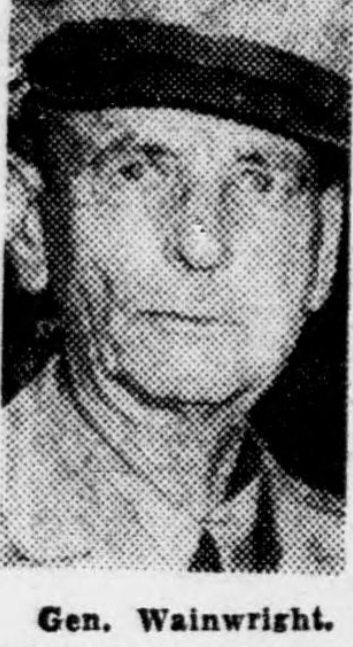 The Jap colonel who had me in
tow after my return to Corregidor
from the fruitless meeting with Lt.
Gen. Homma grinned fiercely when
I now told him I
was ready finally
to meet Homma's full and
cruel demands.
The Jap colonel who had me in
tow after my return to Corregidor
from the fruitless meeting with Lt.
Gen. Homma grinned fiercely when
I now told him I
was ready finally
to meet Homma's full and
cruel demands.
He led me around Malinta Hill to its west side and down to a little settlement on Corregidor named Bario San Jose. And there, in a destroyed Filipino market, I was presented to a stocky Jap colonel in charge of the invading forces.
From him I learned that a second large complement of Japs had landed at "Bottomside" during the afternoon. They were now in full command of the area between the west entrance to the tunnel and Morrison Hill, farther west. They were blocking both ends of the tunnel, our last possible hideout, and the Jap colonel in charge was even then in the midst of an order to his troops to attack "Topside," western extremity of Corregidor, where some of our men still stood by their destroyed weapons.
Last hope vanishes.
That was it. The last hope vanished from my mind.
- Gen. Wainwright's Own Story, Chapter 22
Wainwright's surrender document is drafted
 By feeble light we drew up a
surrender document which followed
the hard terms laid down by
Homma. It was just midnight when
I scrawled my signature across the
bottom. The document, typed in
the stiff Japanese version of English,
read:
By feeble light we drew up a
surrender document which followed
the hard terms laid down by
Homma. It was just midnight when
I scrawled my signature across the
bottom. The document, typed in
the stiff Japanese version of English,
read:
"Imperial Japanese Army and Navy are only prepared to accept surrender all forces under your command.
"To troops operating in other part of the Philippine Islands the order shall be given to disarm voluntarily immediately and to take the understipulated steps.
"Those remaining in Northern Luzon to assemble at Boyongbon or Bontoc and the commanding officer to present himself to Japanese Army in Baguio and notify him of their surrender. Those remaining on Panay Island to assembled northern environs of Iloilo City, on Negros Island in the vicinity of Bacalod City, and the commanding officers of both regions to present themselves to Japanese Army in Iloilo and notify of their surrender.
"Those remaining on Bohol Island to assemble in the vicinity of Roai and the commanding officers to present themselves to Japanese Army in Cebu and notify of their surrender. Those remaining on Leyte Island and on Samar Island to assemble in the vicinity of Tacloban and Catabalagan, respectively, and the commanding officers to present themselves to Japanese Army in Legaspi and notify of their surrender.
Assembly Points Listed.
"Those remaining in the district of Lanao and Zamboanga in Mindanao Island to assemble in the vicinity of Iligan and those remaining in the district of Malaibalai and Agusan Basin to assemble in the vicinity of Malaibalai and Butuan and their commanding officers to notify of their surrender.
"Those in other islands not mentioned above to assemble at any convenient places and notify the nearest Japanese Army of their surrender.
"The order shall be carried out within four days.
"(B) It is strictly prohibited to destroy, burn or disperse arms, materials, vessels and any establishments, either part or whole.
"(1) Portable and easily-movable weapons to be gathered all together in the vicinity of the assembling places of the troops.
"(2) Heavy arms, materials and equipment to be kept intact and the location-thereof to be reported with a sketch.
"(3) Vessels in waters other than Manila Bay to proceed to the port of Cagayan.
"(C) Defense measures, specially those areas wherein land mines or sea mines were laid, to be reported with a sketch, and the actual position to be distinctly indicated by suitable means, if such is at all possible.
"(D) Japanese prisoners of war, if any, to be handed over immediately.
"(E) Further order will be given if such is found necessary.
"Japanese Army and Navy will not cease their operations until they recognize faithfulness in executing the above-mentioned orders.
"If and when such faithfulness is recognized, the commander in chief of Japanese forces in the Philippines will order 'cease fire' after taking all circumstances into considération."
- Gen. Wainwright's Own Story, Chapter 22
Intending to surrender only a limited force, Wainwright Relinquishes overall Command.
General Sharp of the Visayan-Mindanao Command would report to MacArthur directly.
On the morning of 6 May General Sharp (Commander of the Visayan-Mindanao Force) received two messages.
The first was the one in which Wainwright relinquished command of the Visayan-Mindanao Force and directed Sharp to report to MacArthur for orders.
The second was from General MacArthur who, on learning of the surrender of Corregidor and without knowledge of Wainwright's instructions to Sharp, immediately ordered the commander of the Visayan-Mindanao Force to "communicate all matters direct to me."[46] With this dispatch MacArthur assumed command of the Visayan-Mindanao Force.
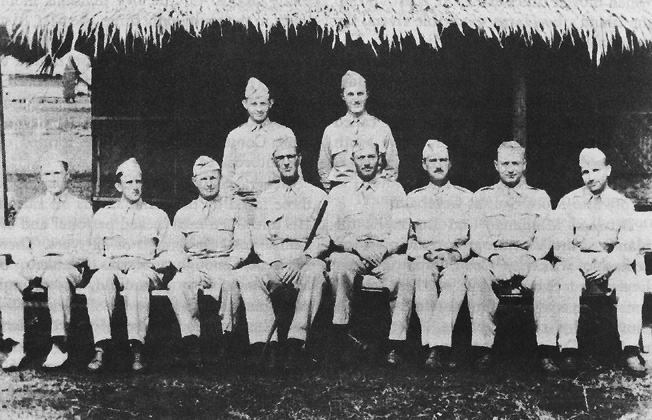 MAJ. GEN. WILLIAM F. SHARP AND HIS STAFF, 1942. Back row, standing left to right: Maj. Paul D. Phillips (ADC) and Capt. W. F. O'Brien (ADC). Front row, sitting left to right: Lt. Col. W. S. Robinson (G-3), Lt. Col. Robert D. Johnston (G-4), Col. John W. Thompson ( C of S ) , General Sharp (CG), Col. Archibald M. Mixson ( D C o f S ) , Lt. Col. Howard R. Perry, Jr. (G-1), Lt. Col. Charles I. Humber (G-2), and Maj. Max Weil (Hq Comdt and PM). Photo from https://www.history.army.mil/books/wwii/5-2/5-2_28.htm |
Japanese tells Wainwright to surrender whole Philippines.
Wainwright writes to Gen. Sharp
Taken Under Guard.
When the terrible thing (drafting of Wainwright's surrender document) was done, I was taken under guard to the west entrance of the tunnel.
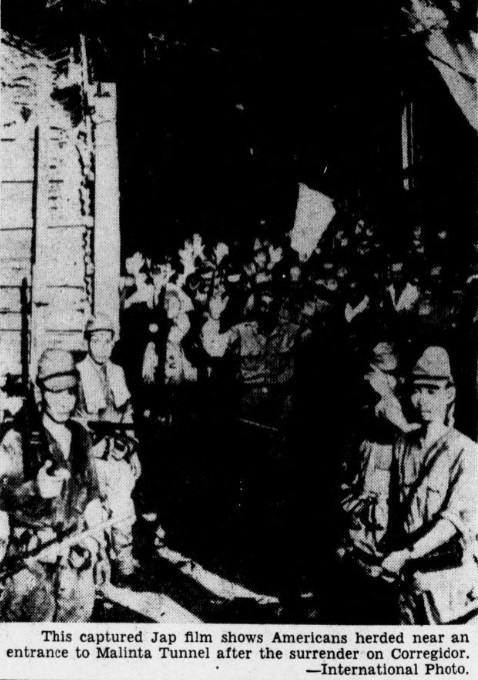
And on the way I passed through hundreds of my men, herded in a place near the west end of the tunnel. They had been rounded up while I was on Bataan that afternoon, and now they stood there unarmed in the hot night, without food or water.
As I passed through them, many of those gallant fellows reached out and took my hand, or patted me on the shoulder and said, "It's all right, general, you did your best."
My eyes were filled with tears by the time I reached the tunnel.
There, as an additional blow, I found Jap troops in full command of the Interior. There were practically no Americans or Filipinos in evidence, except the silent men on their hospital cots.
I went immediately to Maj. Gen George F. Moore and told him that I had totally surrendered. To have refused any longer, I told him, would have caused the annihilation of the people of Corregidor, at no permanent advantage to the men left on the other islands.
Moore agreed with me that, with no aid in sight, a short period of continued warfare in the southern islands would in no way compensate for the massacre of the men and women on the fortified islands.
Dreadful Step Taken.
"But I feel I have taken a dreadful step," I concluded.
I went back to my room with Pugh, the sentry following us. We threw ourselves on our cots and closed our eyes for the first time since two nights before.
I slept about three hours. At dawn Sergt. Carroll came in and awakened me. He had a cup of coffee which
This captured Jap film shows Americans herded near an entrance to Malinta Tunnel after the surrender on Corregidor.
—International Photo.
he had somehow not only managed to get from the hospital but also to spirit past the Jap sentry. I aroused myself, got up and made a point of making myself more respectable in appearance.
While I was dressing, a Jap colonel strode into the little room, accompanied by the same insolent Nakamura who had interpreted for Homma.
"Are you Gen. Wainwright?" the Jap colonel demanded. He knew very well that I was. I nodded.
"I am Col. Haba of the general staff and of Gen. Homma's headquarters," he said. "I am here to discuss the details of your surrender."
One of the first details, I knew, would be the task of sending word to Sharp on Mindanao that I was resuming command of his troops, by virtue of authority vested in me by the President, and ordering him to surrender.
Writes Order for Sharp.
With that in mind I sent for Col. Jesse T. Traywick, my assistant chief of staff for operations, and dictated to him the instructions I wished to go to Sharp. They read:
"Subject: Surrender.
"To: Maj. Gen. William F. Sharp, jr., commanding Visayan-Mindanao force.
"To put a stop to further useless sacrifice on human life on the fortified islands, yesterday I tendered to Lt. Gen. Homma, the commander in chief of the imperial Japanese forces in the Philippines, the surrender of the four harbor forts in Manila Bay.
"Gen. Homma declined to accept my surrender - unless it included the forces under your command. It became apparent that the garrisons of these said forts would be eventually destroyed by aerial and artillery bombardment and by infantry supported by tanks, which have overwhelmed Corregidor.
"After leaving Gen. Homma with no agreement between us I decided to accept in the name of humanity his proposal and tendered at midnight, night 6-7 May, 1942, to the senior Japanese officer on Corregidor, the formal surrender of all American and Philippine Army troops in the Philippine Islands. You will therefore be guided accordingly, and will repeat will surrender all troops under your command, both in the Visayan Islands and Mindanao, to the proper Japanese officer. This decision on my part, you will realize, was forced upon me by means beyond my control.
"Col. Jesse T. Traywick, jr., G. S. C, my assistant chief of staff, G-3, who will deliver this letter to you, is fully empowered to act for me. You are hereby ordered by me as the senior American Army officer in the 'Philippine Islands to scrupulously carry out the provisions of this letter, as well as such additional instructions as this staff officer may give you in my name.
"You will repeat the complete text of this letter, and of such other instructions as Col. Traywick may give you, by radio to Gen. MacArthur. However, let me emphasize that there must be on your part no thought of disregarding these instructions. Failure to fully and honestly carry them out can have only the most disastrous results."
- Gen. Wainwright's Own Story, Chapter 22
Wainwright Surrender Broadcast
The first intimation Sharp had of Wainwright's intention to reassume command came from the latter's radio broadcast on midnight of the 7th. He immediately repeated the gist of the broadcast, which directed him in unmistakable terms to surrender, to MacArthur and asked for further instructions.
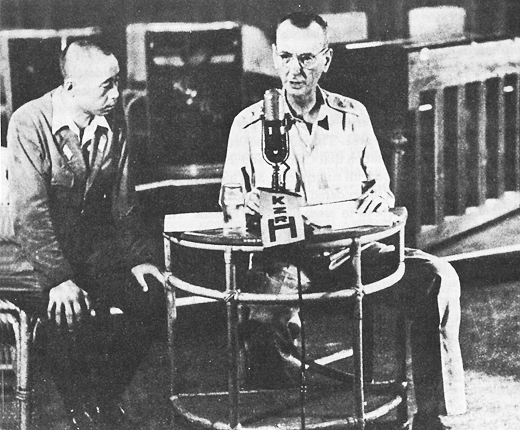
GENERAL WAINWRIGHT BROADCASTING surrender instructions over Station KZRH, 7 May 1942.
MacArthur countermands Wainwright's attempt to reassume command, and tells everyone to initiate guerrilla operations.
The reply from Melbourne came promptly: "Orders emanating from General Wainwright have no validity. If possible separate your forces into small elements and initiate guerrilla operations. you, of course, have full authority to make any decision that immediate emergency may demand."[47] At the same time, MacArthur informed the Chief of Staff of Wainwright's broadcast and of his own orders to Sharp. "I believe Wainwright has temporarily become unbalanced," he concluded, "and his condition renders him susceptible of enemy use."[48]
General Sharp is made aware by Gen. Wainwright of what will happen if Sharp doesn't surrender
When General MacArthur made this judgment he was probably unaware of the circumstances which had dictated Wainwright's course of action during and after the surrender of Corregidor. He could not have realized that it was the fear of what would happen to the 11,000 men on Corregidor which had forced Wainwright to accept Homma's terms. Wainwright believed, as did many of the American officers on his staff, that the Japanese would kill their prisoners in cold blood if the commanders in the south did not surrender.[49]
There is no direct evidence that the Japanese actually made such a threat. In 1946, during the course of the Homma trial, Colonel Pugh stated that he had no personal knowledge that a threat had been made. But he added that General Wainwright certainly believed his men would be killed
--575--
if Sharp did not surrender.[50] One the same occasion Wainwright testified that the Japanese told him they did not regard the Americans as prisoners of war but as hostages, "held to insure the success of the negotiations with forces in the south. . . ." "My principal concern," he said then, "was for fear that they would do what they said they would do; that is, slaughter all those people in the fortified islands unless the troops all over the Archipelago surrendered."[51]
Added to the thread, real or imagined, of what might happen to these men, practically all of whom were concentrated in a small area on the beach at Corregidor, was the threat reported to have been made to the men on Corregidor. For every day that the surrender was delayed, they were told, ten American officers would be executed. Wainwright admits he did not know of this threat at the time, and if made it was certainly never carried out.[52]
General Sharp's position on 8 May was not an enviable one. First Wainwright had released him and now sought to reassert his control. He had reported to MacArthur and from him had received complete authority to act on his own judgment. His legal right to ignore Wainwright's reassumption of command and order to surrender was undeniable. But from the Manila broadcast he had received some intimation of the possible consequences of such a course. He decided, therefore, to await the promised arrival of Wainwright's emissary, Colonel Traywick, before making his decision. In the meantime, in accordance with MacArthur's instructions, he released from his control the island commanders in his force and directed them to prepare for guerrilla operations.
Gen. Sharp finally agrees to place his command again under Gen. Wainwright, and accept the order to surrender.
Colonel Traywick and Colonel Haba reached Mindanao by plane on the 9th and arranged a meeting with Sharp for the following day. At daybreak of the 10th hostilities were suspended temporarily, and during the afternoon Colonel Traywick, with Haba and several other Japanese officers, met General Sharp at his headquarters at Malaybalay on the Sayre Highway.[53] Traywick delivered Wainwright's letter and told Sharp the circumstances which had led to its preparation. He made clear that if the Visayan-Mindanao Force was not surrendered, the Japanese would probably reject the terms already agreed upon and would open fire on the prisoners on Corregidor. It was this threat that forced General Sharp to capitulate.[54]
General Sharp's decision to surrender placed him in exactly the same position
--576--
Wainwright had been in on 7 May. He now had to reassume command of the officers he had released for guerrilla operations the day before. This he did on 10 May in a clear text message--he had destroyed his codes--rescinding his earlier instructions and directing his subordinate commanders to cease all operations at once, stack arms, and raise the white flag. One of his staff officers, he told them, would soon arrive with written orders and with detailed instructions. These orders, he concluded, were "imperative and must be carried out in order to save further bloodshed."[55] Later that night, at 1915, he announced his decision to General MacArthur. "I have seen Wainwright's staff officer," he explained, "and have withdrawn my order releasing commanders on other islands and directed complete surrender. Dire necessity alone has prompted this action."[56]
It was with great relief that General Wainwright heard from Colonel Traywick when that officer returned to Manila on 11 May that General Sharp had decided to place his forces again under Wainwright's command and to accept the order to surrender. This decision, he believed, averted a massacre and saved the Corregidor garrison.[57]
Wainwright's relief was premature. General Sharp's surrender orders proved far more difficult to enforce than had been anticipated. His troops were scattered among many islands; most of them were untrained Filipinos; and those who were safe in their mountain hide-outs showed no disposition to give up their freedom. Communication between the islands was poor and it would be some time before the last troops laid down their arms. Until then the fate of the Corregidor garrison hung in the balance.
The detailed instructions to each commander were sent by courier on the 11th. In each case the commander was directed to assemble his men at a designated point and at a certain time. General Chynoweth, for example, was to bring his men to the northern outskirts of Cebu City; Christie to Iloilo City, and Colonel Cornell, commander of the Leyte-Samar Force, to Tacloban and Catbalogan. Land mines and other explosives that might cause injury or damage to the Japanese were to be removed within twenty-four hours, and those that could not be removed were to be plainly marked. All commanders were warned against the destruction of military of civilian property and urged to accord the Japanese "courteous and prompt obedience."[58]
Gen. Sharp tells Panay Commander Colonel Christie to surrender.
Of all the island commanders none was better prepared for guerrilla operations than the Panay commander, Colonel Christie. His forces were comparatively well trained and organized, his supplies ample, and his position secure. The Japanese had control of the road network on the island but showed little disposition to embark on operations in the interior. Already Christie had had some success in hit-and-run raids, and the one attempt at retaliation had ended in disaster for the Japanese. He had every reason to believe, therefore, that he could hold out indefinitely.[67]
Sharp's clear text message of 10 May directing him to surrender came as a shock to Colonel Christie. He acknowledged receipt of the order promptly, but expressed his opposition to it in very strong terms and questioned General Sharp's authority to issue such an order. He did not see "even one small reason" why he should surrender his force, because "some other unit has gone to hell or some Corregidor shell-shocked terms" had been made. "To satisfy me," he wrote, "I must have MacArthur's okay; otherwise it may be treason." He closed his message with an appeal to General Sharp to give him a free hand in dealing with the enemy on Panay.[68]
General Sharp refused to accept Christie's answer and directed him to hoist the white flag and cease all operations at once. "Your failure to comply," he warned, "will produce disastrous results." Neither Wainwright's nor his surrender, he explained, had yet been accepted, and unless all the island commanders capitulated the Japanese would resume offensive operations. MacArthur, he told Christie, had been informed of his actions, and an officer, Colonel Thayer, was leaving by plane for Panay with written instructions and a personal message. He concluded his message with instructions for an immediate reply "indicating your compliance and actions."[69]
Colonel Christie persisted in refusing to accept Sharp's order, arguing, first, that it was unnecessary, second, that it would have an adverse effect on the civil population, and third, that he doubted the authority of either General Wainwright, or General Sharp to order his surrender. He felt that to comply with Sharp's directions would "tend toward treason," and questioned whether the surrender of one island meant the automatic surrender of others. "I strongly urge you," he told General Sharp, "to have the approval of the War Department through MacArthur," adding that he intended to consult his immediate commander, General Chynoweth. He closed his message with a pleas. "In this delicate situation please do not issue me any peremptory orders that will embarrass or get us into mutual conflict.
--579--
Rather do I want a free hand in carrying out my mission uninfluenced by any hysteria inherent in local action. No army surrenders portions still free, intact, and having a good chance of helping the general mission. Make me independent. Do not put me on the sacrifice block."[70]
Col. Thayer lands on Cabatuan Airfield bearing Sharp's letter to Christie.
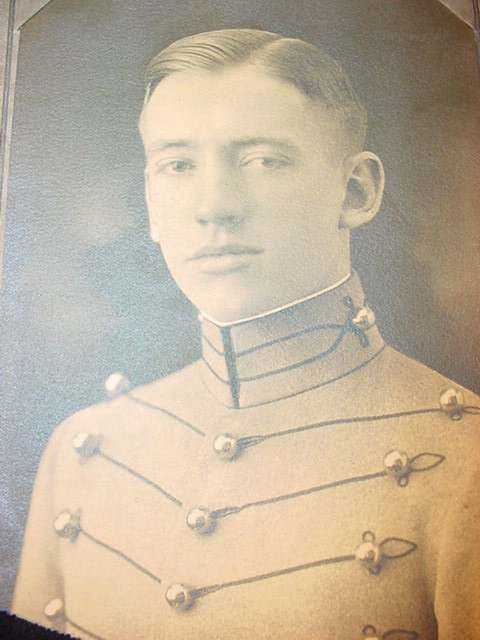 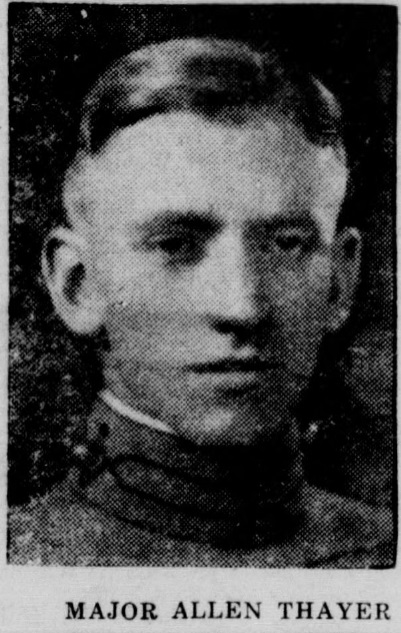 ALLEN THAYER West Point Class 1928 |
Before Thayer's arrival with the letter, Christie sent Sharp another message asking what General MacArthur had said in response to Sharp's surrender message. As a matter of fact, MacArthur had not replied to this message at all. By this time Sharp had lost all patience with Christie. His reply was a curt order to surrender as directed. "No further comments from your are desired," he told Christie. "Acknowledge this message and state actions taken at once."[72]
Colonel Thayer finally reached Panay on 19 May. He explained to Christie that acceptance of Wainwright's surrender of Corregidor was conditional on the surrender of all forces in the Philippines, and that Christie's refusal to comply with orders was jeopardizing the success of the negotiations and the lives of the 11,000 men on Corregidor. The question Christie had to answer, therefore, was the same one the other island commanders had to answer: Was the holding of Panay, or any other island, important enough to justify the death of the Corregidor prisoners? He decided that it was not, and made arrangements to surrender.[73]
|
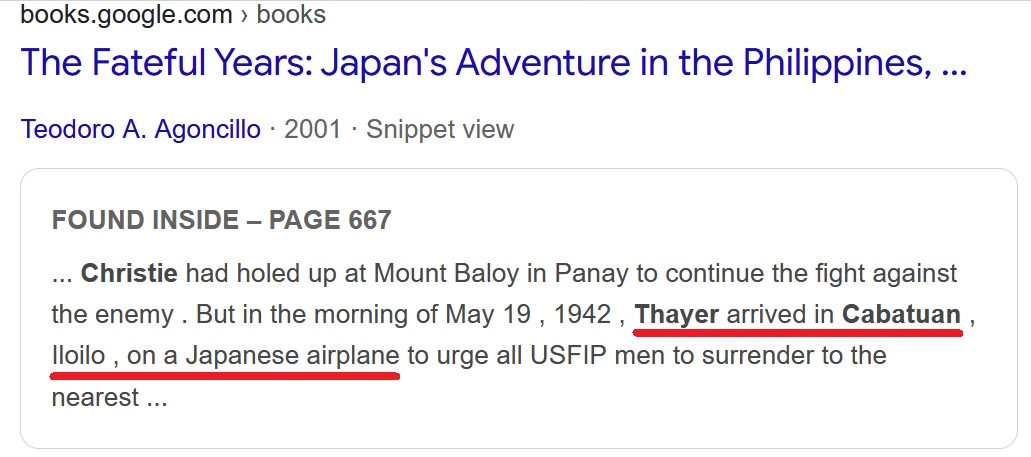
May 19, 1945 - Lt. Col. Allan Thayer, staff officer of the USFIP, arrived at Cabatuan Airfield (in Cabatuan, Iloilo) in order to coordinate the surrender of the USAFFE in Panay. - The Blood and Mud in the Philippines |
|
During the time that the Kawamura Detachment was operating in Panay, the Japanese forces in Luzon had launched a general attack on Corregidor. At Corregidor on May 6, 1942, US Lieutenant General Jonathan Wainwright surrendered all US and Philippine forces that had been resisting the Japanese throughout the Philippine Islands.
Lieutenant Colonel Alan Thayer was a staff officer of the USFIP (US Forces in the Philippines) assigned to the Visayas and Mindanao.13 In the early morning of May 19, he flew to the town of Cabatuan, Iloilo, with Japanese escorts. He relayed the order of surrender issued by Major General Willlam F. Sharp, Commander for Visayas and Mindanao to Colonel Alben Christie of the 61st Division situated at Mt. Baloy. - The Blood and Mud in the Philippines, Section 1.2 |
|
Before he assembled his men, Christie made one more effort to satisfy himself on the legality of his course. To each of his fellow commanders he sent a message explaining what he was doing and why, and asked each what action he had taken. Chynoweth had already surrendered, but Colonel Hilsman, who was having troubles of his own on Negros, wrote that "we must surrender or be classed as deserters by our own country and as outlaws by international law."[74] That night Colonel Christie informed General Sharp that he had talked with Thayer and had decided "to comply faithfully with your orders for the surrender of my division."[75] Two days later he
--580--
marched his troops to the Japanese lines. By that time approximately 90 percent of his men had vanished into the hills or gone back to their homes.[76]
https://www.ibiblio.org/hyperwar/USA/USA-P-PI/USA-P-PI-32.html

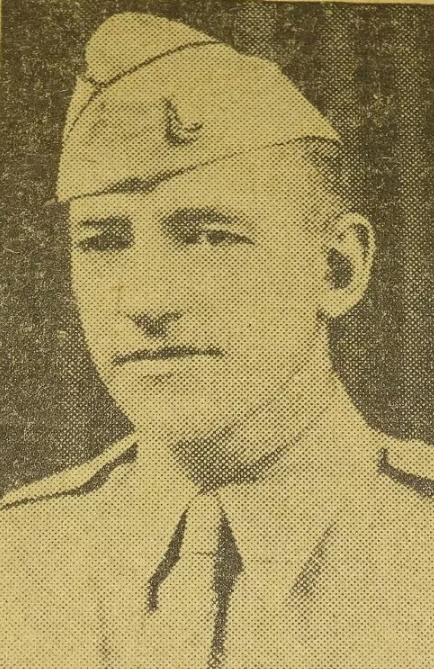 Service Member
Lt. Col. ALLEN THAYER
Conflict WORLD WAR II
Service UNITED STATES ARMY
Status Unaccounted For
On December 13, 1944, Japanese forces in the Philippines began the transfer of 1,621 Allied prisoners of war (POWs) to Japan. The POWs were to make the journey aboard transport ships whose harsh conditions and extreme overcrowding led survivors to refer to them as "Hell Ships." The ships also lacked markings that would distinguish them from any other military target, causing some of them to be attacked by Allied forces who could not identify them as POW transports. On December 14, 1944, Allied aircraft attacked the first ship, the Oryoku Maru, in Subic Bay in the Philippines, killing many Allied POWs who became lost in the water, sank with the ship, or were washed ashore. Survivors of the bombing were put aboard two other ships, the Enoura Maru and the Brazil Maru, to continue on to Japan. During its journey on January 9, 1945, while anchored in Takao Harbor, Formosa (present-day Taiwan), the Enoura Maru was attacked by Allied aircraft from the USS Hornet (CV-8), killing Allied POWs who were lost in the water, on board the ship, or on the nearby shore. Survivors of the Enoura Maru bombing were loaded onto the Brazil Maru, and reached Japan on January 30, 1945. As a result of these incidents, Allied POWs were lost in the Philippines, at sea between the Philippines and Taiwan, while anchored in Taiwan, at sea between Taiwan and Japan, and in Japan. The attacks on these POW transports ultimately resulted in a series of death notifications from the Japanese government through the International Red Cross (IRC), and some casualties were given up to five different dates of death at various locations during the transfer. Witness accounts from surviving POWs offer detailed information for a handful of casualties, but the specific dates of loss and/or last-known locations for many of these POWs are based on the most recent reported date of death. Lieutenant Colonel Allen Thayer entered the U.S. Army from Connecticut and served with the 23rd Field Artillery Regiment (Philippine Scouts) in the Philippines during World War II. He was taken as a POW following the Japanese invasion and was interned in the islands until December 1944, when he was transferred to the Oryoku Maru for transport to Japan. He survived the attack on the Oryoku Maru and was eventually transferred to the Brazil Maru. Records indicate that LTC Thayer died of starvation and exposure while aboard the Brazil Maru on January 29, 1945, and was reportedly buried at sea. However, these records often involve information solely furnished by enemy governments, with some casualties given multiple dates of death. Future research may determine these reports were inaccurate. LTC Thayer's remains could not be identified following the war, and he is still unaccounted-for. Today, Lieutenant Colonel Thayer is memorialized on the Walls of the Missing at the Manila American Cemetery in the Philippines.
Based on all information available, DPAA assessed the individual's case to be in the analytical category of Non-recoverable.
Lt. Col. ALLEN THAYER
Unit BRAZIL MARU; 62 INFANTRY 61 DIVISION (PHILIPPINE SCOUT)
Historical Country of Loss China Seas
Body of Water TSUSHIMA STRAI
T Current Country of Loss JAPAN
Lt. Col. Allen Thayer, U.S. Army (1905-1945) – died in captivity
By Michael Rocchetti
By December of 1944, Allied Forces were closing in on the home islands of Japan, and General MacArthur’s forces had returned to the Philippines to liberate those islands from the Japanese occupation. The Japanese forces were retreating, but they were not allowing their Allied prisoners to remain in the Philippines. There were thousands of U.S. troops that had been captured by the Japanese after the fall of Corregidor in early 1942, and these prisoners were forced to endure brutal and inhumane treatment during the infamous Bataan Death March and during the long years of captivity in the Philippines.
In late 1944, the Japanese started transferring U.S. and Allied POWs from prison camps in the Philippines to slave labor camps in Japan – and they were using unmarked troop ships to transport these POWs. These troop transport ships were seen as legitimate military targets by U.S. aircrews and were bombed repeatedly. Unfortunately, in the fog and friction of war, more than 1,600 U.S. POWs were killed in these air attacks. Among them was Lt Colonel Allen Thayer from Putnam. Allen Thayer was born June 7, 1905, in Willimantic, the son of Mr. and Mrs. Charles A. Thayer of 19 King St., Putnam. He graduated from Putnam High School in 1924. He was later commissioned as a 2nd Lieutenant in the Army upon graduation from the U.S. Military Academy at West Point in 1928. As an Army officer, he served in various parts of this country and was then detailed to the Philippine Islands. Although his wife and three sons had evacuated the Philippines, he was still in the Islands when war with Japan broke out. He was active in the entire defense of the Philippines and was not taken prisoner until the end of the resistance.
Allen Thayer was captured by the Japanese during the fall of Corregidor in May of 1942 while assigned to the 62nd Infantry Regiment of the 61st Infantry Division, the “Philippine Scout Division”. According to information obtained from the Defense POW/MIA Accounting Agency, Lt Col Allen Thayer was lost during the sinking of the Japanese transport ship Brazil Maru while in transit as a POW from the Philippines to Japan. He was lost somewhere in the China Seas near the Tsushima Straits of Japan.
His death date is officially listed as Jan. 18, 1945. He has a cenotaph at the Riverdale Cemetery, in Columbus, Ga. Lieutenant Colonel Thayer is also memorialized on the Walls of the Missing at the Manila American Cemetery in the Philippines.
In addition to his parents, he was survived by a brother Henry, a sister Martha, his wife Marjorie (Roberts) Thayer of Columbus, Ga, and three sons – Allen, David, and John.
He was posthumously awarded the Silver Star Medal. The citation which accompanied the award said that Lieutenant Colonel Thayer won the Silver Star Medal “For gallantry in action while commanding the 62d Infantry in the vicinity of Dalirig, Bukidnon, Mindanao, Philippine Islands, during May 7 and 8, 1942. During periods of heavy shelling of the 62d Infantry by the Japanese, Colonel Thayer made a number of personal visits to his front-line units, thereby inspiring confidence in the unseasoned troops of his command.”
https://www.putnamtowncrier.com/index.php?view=article&id=25367&catid=24
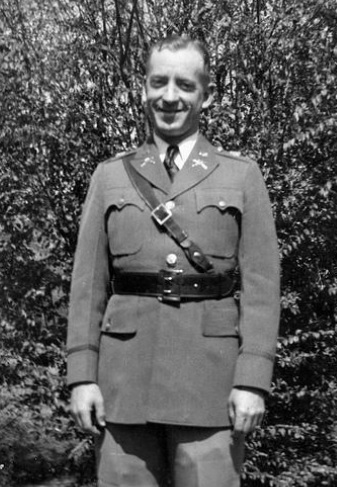 Lt. Col. Allen Thayer Photo provided by Tricia Muno |
Graduating in the West Point Class of 1928, Allen Thayer was proud of his commission and of his ancestor [sic] Sylvanus Thayer, who reorganized the military academy in 1817 as its fifth superintendent. After college, Allen found himself at Fort Benning where destiny introduced him to the daughter of a local eatery known for its scrambled dogs. At the Firm Robert’s Café, Allen met Marjorie Louise Roberts, and their attraction was immediate. They married June 1934 at Marge’s parents home on Benning Road, and eventually they had three sons – Allen, David and John. In 1939, the Thayers sailed for the Philippine Islands. About the time Thayer advanced to the rank of major, the army issued a mandatory evacuation of the islands by all military dependants. Concerned for his wife who would now be raising his three boisterous sons alone, Allen sadly sent them on their way. Later, when Allen received a photograph of his family, he wrote his wife: “Marge, you are doing a wonderful job in caring for these kids, and I never have seen any who looked more healthy. I tell you sweetheart my old heart swells with pride when I think of my family – a beautiful wife and three grand kids . . . You all look so much better than you did in Manila, but that is the only thank I can thank this forced evacuation for . . . I know life is rather discouraging at times, Marge, but keep hammering away sweetheart and never admit that you are whipped down.” Living by example rather than by words, Allen would model this credo for his family and inspire them for generations to come.
In the weeks following Pearl Harbor, Allen was promoted to Lieutenant Colonel and made commander of the newly mobilized 62nd Infantry Regiment of the Philippine Army. In battle on 4 May 1942, Thayer’s men were retreating when the Japanese surrounded them on three sides. Pursued in their retreat by small arms and artillery fire and strafed by low-flying aircraft,
Thayer’s force was decimated, and he was taken prisoner. In the two cards he was able to send home, Allen described his health as “excellent” even though most other prisoners gave less sanguine assessments. He wrote that he looked forward to a grand family reunion when he returned and reminded Marge, “Remember my usual good luck and do not worry.” Two years passed, and Allen continued to “hammer away” and “never admit he was whipped.” As the war in the Pacific turned in the Allies’ favor, the Thayers hoped that Allen would soon be liberated, but the Japanese decided to move the POWs to more secure locations. In December 1944, about sixteen hundred prisoners were loaded aboard the Oryoku Maru. The next morning near Subic Bay, U.S. Navy aircraft spotted the enemy vessel and fired on it three times, killing 942 Americans. Survivors, including Thayer, swam ashore only to be imprisoned again. When aboard a second ship, the US Navy attacked again. This vessel sank near Formosa. Once again, Allen was among the survivors, but this time he was seriously wounded. He died aboard a third ship on 23 January 1945 and was buried at sea. Allen’s sons grew up to be men who would have made their father proud. Allen made the army his career. John became a real estate developer in Columbus. David died in an army training accident in 1962. Allen’s brother-in-law Firm Roberts erected a memorial to the POWs. This monument will soon be moved to the Memorial Walk on the grounds of the new National Infantry Museum.
Thanks to “new” cousin Philip Thayer for sharing this great information on his grandfather.
Source: The Thayer Quarterly, March 2009
