THE BATTLE FOR BATAAN: A JAPANESE OFFICER'S MEMOIR
by Toshimi Kumai
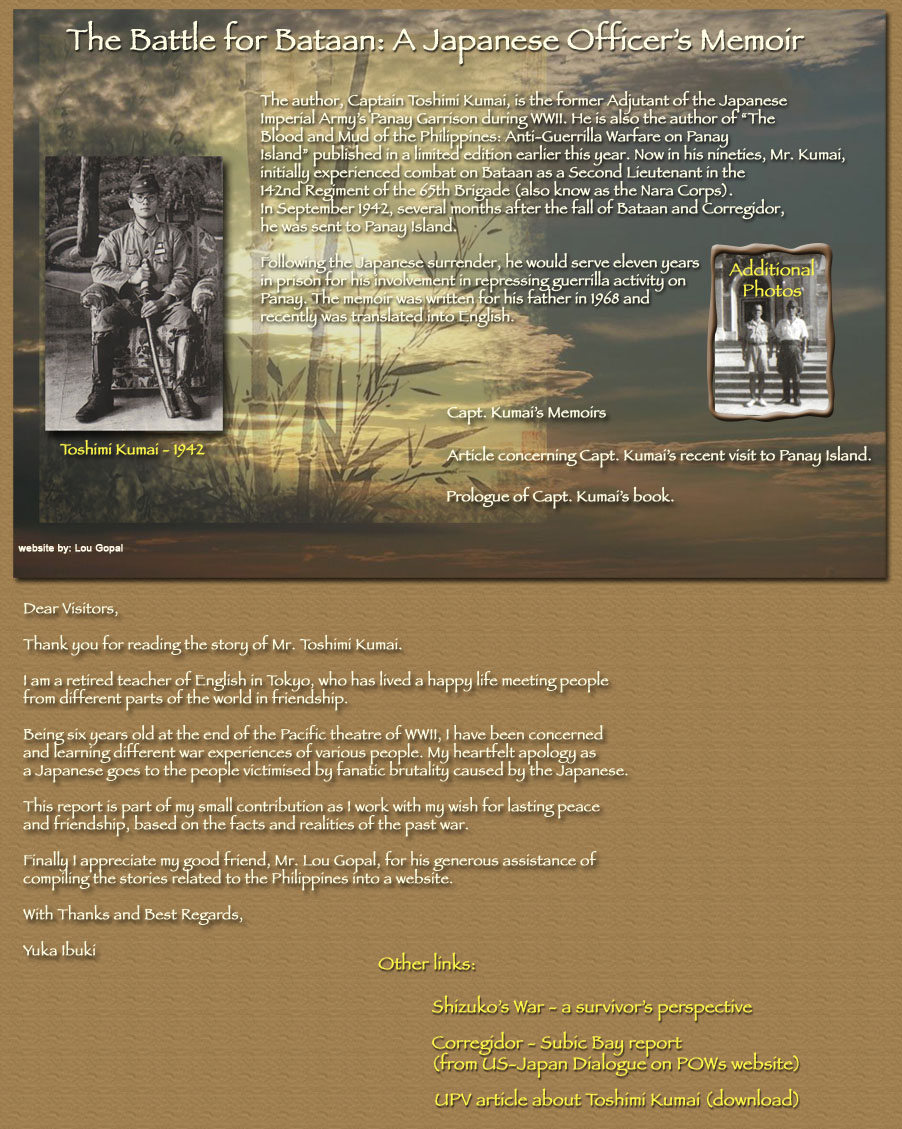
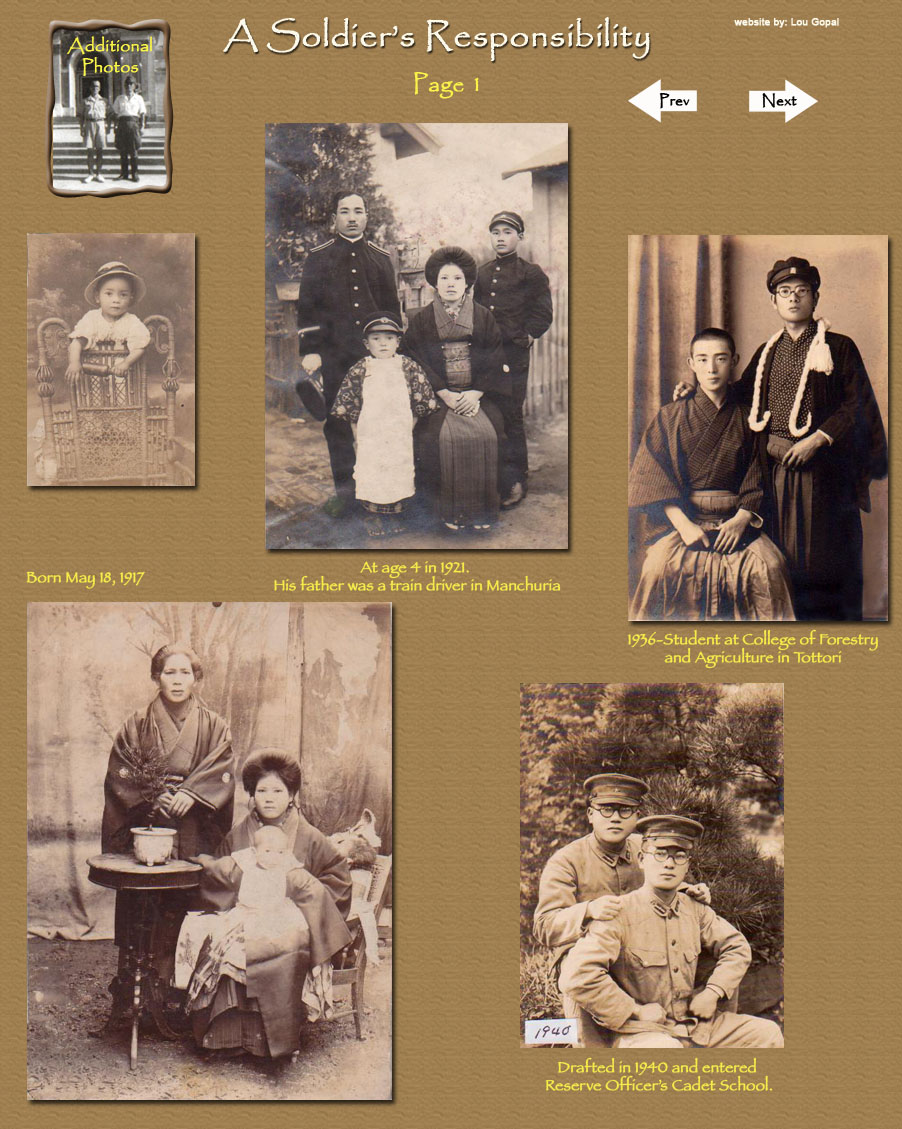
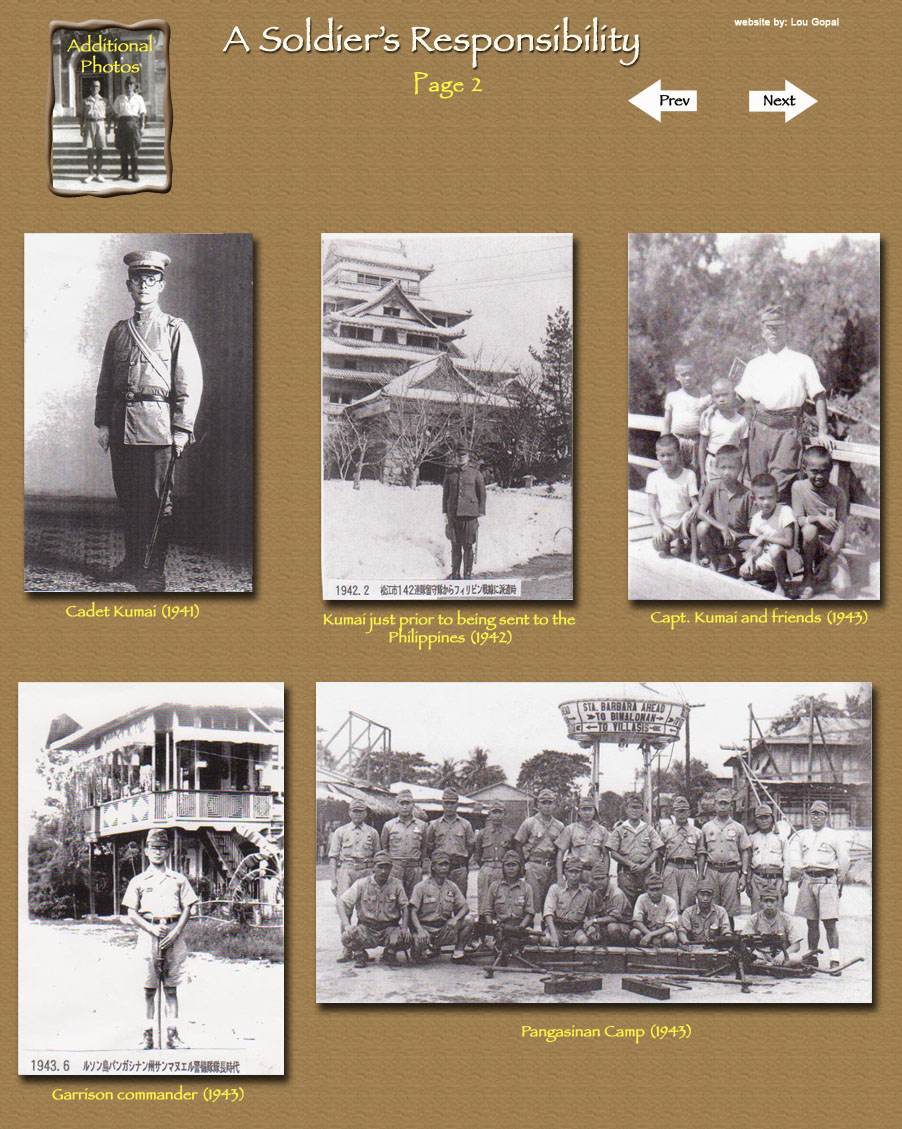
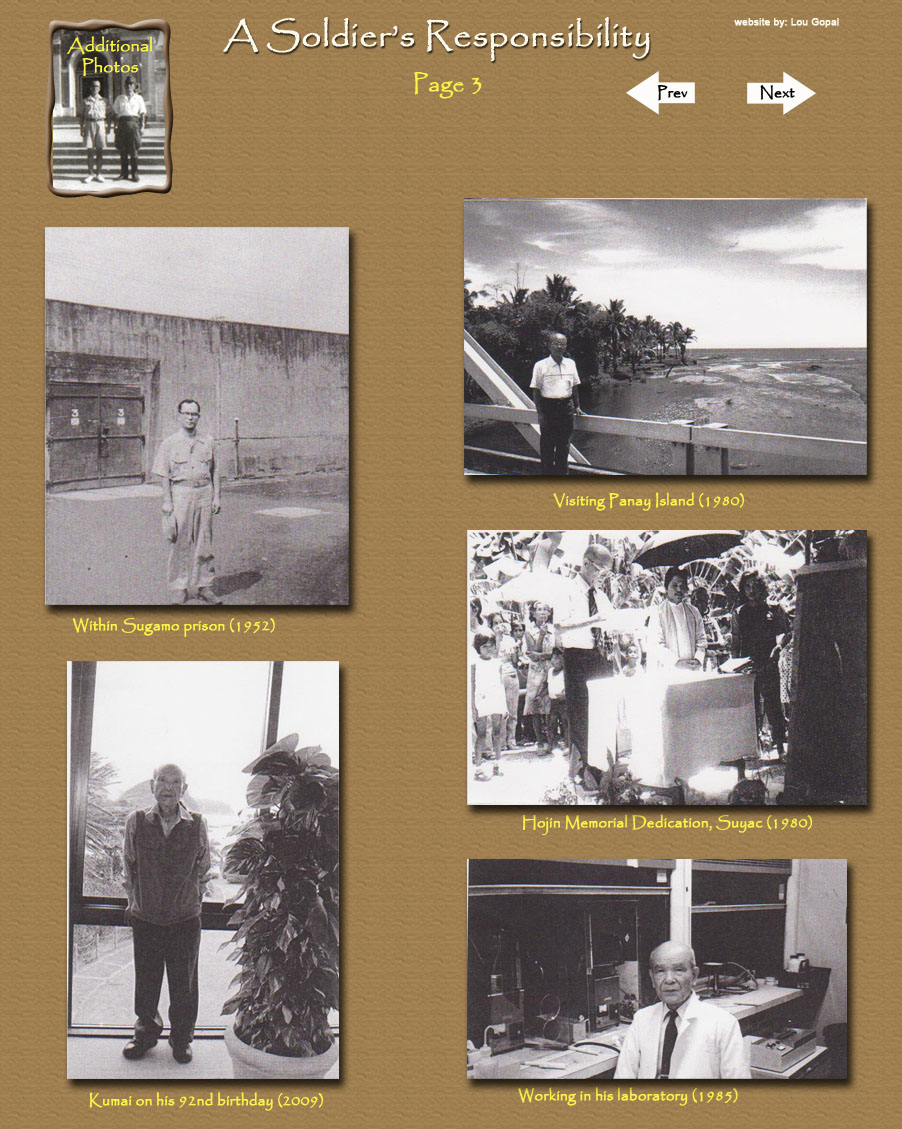
The author, Captain Toshimi Kumai, is the former Adjutant of the Japanese Imperial Army’s Panay
Garrison during WWII. He also is the author of The Blood and Mud of the Philippines: Anti-
Guerrilla Warfare on Panay Island published in a limited edition earlier this year. Now 92, Mr.
Kumai, initially experienced combat as a Second Lieutenant in the 142nd Regiment of the 65th
Brigade (also know as the Nara Corps). In September 1942 he was sent to Panay Island. Following
the Japanese surrender, he would serve eleven years in prison for his involvement in repressing
guerrilla activity on Panay.
Personal Memoir of the Battles in Bataan
Written for his Father by Toshimi Kumai in 1968
Translated by Ms. Yuka Ibuki
Edited by PSHS Historian Mike Houlahan
Introduction
I’ll be fifty-one years old this year, 1968. This is my private memoir to tell my experience in the
battles in Bataan Peninsula in April 1942 to my father and children. Though it is recorded as a
brilliant victory for Japan, the reality was physically the most painful experience in my life. I was a
Second Lieutenant and a gun force platoon leader. I carried the 55 kg machine-gun with my
subordinates at the risk of my life, and, with the pride of a platoon leader, I made desperate efforts
to carry out my duty. Had there been another battle, my and my subordinates’ physical energy
would have reached the limit, and having lost our composure, we might have perished in Bataan.
I. To Bataan Peninsula
I had been commissioned as Second Lieutenant in the Japanese Army, on November 1, 1941, and
at the same time I was ordered to be transferred from my original 24th Regiment of Fukuoka
Prefecture, Kyushu, to 142nd Regiment of Matsue, Shimane prefecture. (Regiments 122, 141 and
142 formed the 65th Brigade.) Around fifteen of us newly appointed lieutenants in new uniforms
departed for Matsue, on the western coast of the Japan Sea, Main Island of Japan. Being in the
middle of mobilization, Matsue city was full of drafted soldiers. We who were transferred from
Fukuoka were ordered to serve in the remaining troop of the 142nd Regiment. The first arrivals in
Matsue had been those from Kokura city, Kyushu, and they were all ordered to join a field
operation on Bataan peninsula, where 70 to 80% of them ended up killed in action. The next
arrivals were those from Ohita prefecture, Kyushu, half of whom were ordered to serve in the
remaining troop, and the other half in a field operation. Our Fukuoka group arrived in Matsue last.
Thus, otherwise trivial order of arrival fixed our fate. (My original home unit, the 24th Regiment,
was later mobilized as the 113th Regiment of the 56th Division, which was sent to Burma, where
most were annihilated.)
In the beginning of February 1942, I was in the officers meeting room of the Western Army’s
46th Unit in Matsue. The media were reporting brilliant victories on Bataan Peninsula. However, we
were listening to a grave and heart-rending report by Regimental Commander Tobita of the Mt.
Natib Offensive carried out by the 65th Brigade. We learned that two thirds of the Brigade perished
in the battle.
Following the report, names of those who were summoned as recruiting officers for the 65th
Brigade were announced. I prayed that my name would not be called thinking of my mother who
had been seriously ill with TB, but I was called. On Feb. 21, while we were waiting for our flight at
Tachi-arai Airport, my mother passed away. Unable to wait for the funeral, I bade farewell to my
mother at our home in Yawata, leaving behind my father, brother and sisters. On February 27, we
recruiting officers departed for Manila via Shanghai and Taipei, Formosa, arriving in Manila on
March 3. The city was so beautiful, and in the few days I stayed in the Manila Hotel, which was full
of luxurious accommodations, I wandered if I were in a dream.
On March 5, we were transported in three unclean military trucks along a wonderfully
constructed main road. As we got out of Manila, the villages of the Philippines were there in the
image I used to have in Japan. Young boys in dirty shirts shouted here and there, “Give me a
cigarette”. In an hour we reached quite a big town of San Fernando. It seemingly was the location of
a Japanese Head Quarters. The town was full of Japanese soldiers. While we took a short rest,
around a dozen NCOs and soldiers surrounded us, asking to which unit we belonged. On hearing it
was Nara Corps, one after another they vented frustration and criticism, “Nara Corps? They are no
good. They are awfully bad at fighting.” Whispers were also heard from among the officers of our
group, “In the Middle-China battles the Nara Corps Commander was well-known to have produced
a lot of damage. Is he also known for a large number of deaths in action?” Those soldiers seemed to
have believed the comments by their senior officers at the HQs. We asked them, “How many enemy
are there? We thought the Philippine Campaign was finished by the assault on Manila, and we were
just sweeping up the remaining enemy.” Their understanding seemed to be the same, but at their
ranks, they didn’t know any more. It was certain that Nara Corps was heavily hit by the US and
Filipino Forces, and was exhausted at the moment, having no strength for attacking the enemy
forces.
We had already seen some deserted or turned over vehicles before reaching San Fernando. The
further beyond the town we advanced, the bigger was the number of burnt down civilian houses and
burned out vehicles. In one place, quite a big town was completely burnt down with nothing left.
Eventually all the villages turned into burnt fields and no local people were seen, making us feel it
might be the new battle field in a southern part of the peninsula. Only the tropical sun was
scorching us. In only three hours, from the heaven of the Manila Hotel we fell into the bottom of
hell.
We reached the town of Orani, where three or four civilian houses were destroyed, Twenty of us
assigned to 142nd Regiment reported to the sun-tanned and gaunt 65th Brigade Commander, Lt.
General Akira Nara. His voice was vigorous and he was an experienced war-veteran, who had
studied in the US and knew a lot about the situation of the US Forces and their ways of fighting. He
expressed no emotion of regret or sympathy for the large number of lost lives, except his regret at
losing a great chance of victory by a hair’s breath at Mt. Natib. He told us that, at that moment in
the front line, both sides were facing each other so closely that the others’ voices could be heard.
We also learned for the first time, from Commander Nara and other officers of the HQs, that we
were going to fight against the USAFFE (the United States Armed Forces Far East) commanded by
General MacArthur, whose HQs was on Corregidor Island where they had a modern underground
fortress.
Met by the officers and NCOs of the Regiment, everyone asked after the colleagues they knew.
Most of them had been killed or wounded in action, leaving only six or seven officers of the
Battalion. Sixty percent of the NCOs and soldiers, and nearly all the officers were annihilated. We
had to renew our resolution as there was no hope for us to survive.
II. Bataan Peninsula: 5 to around 24 or 25 of March
From that point, we were told we entered within the shooting range of the enemy, so we stayed in
Orani untill it was dark, and started again into the mountains. The trucks advanced over hastily
constructed mountain paths, with the lights turned off,. It was near Mt. Natib in the north east of
Bataan peninsula. We were informed it was this area that in the fights against the superior US
Filipino Forces, Nara Corps received devastating casualties, and a lot of our colleagues fell.. It was
so quiet in the mountain forests that we became suspicious that it was not a battle field. Eventually
the car stopped. The guiding officer told us it was the 142nd Regiment HQs, and we would report to
the Regimental Commander and then head for our Battalion, and then to our Company.
We were guided to somewhere that seemed like a cave. The 142nd Regimental Commander Col.
Shotaro Yoshizawa’s exhausted and awfully gaunt figure revealed the fierceness of the past battles,
with his proud Kaiser mustache drooping like a goat’s, his speech and greetings sounding as if
listening to someone ill. We paid respect to the Regiment Flag, but the flag holder, a 1st Lt., also
looked to be in extreme fatigue. How awful! Even if it were war, we were assigned to somewhere
horrible; I felt anew some emotions similar to resignation and psychologically giving-up.
In the dark, we were then guided to report to 1st Battalion Commander, Lt. Col. Kanji Tanabe.
Contrary to the Regiment Commander, although a bit thin, he was in high spirits. He made me feel
a little better. I realized that in such situations the facial expressions and posture of the senior officer
affected the morale of his subordinates. I renewed my resolution: from now on I have to behave
with composure to give a sense of security and reliability to my subordinates. The Battalion
Commander advised us in his speech, “The soldiers and NCOs who are to be your subordinates
have gone through continuous fierce battles and though it has not been long since the unit was
formed, they have already got a certain solidarity among them, so you should try to become part of
this as fast as possible.”
The 1st Battalion consisted of three infantry companies, each of which consisted of three
platoons, 1st Machinegun Company of the 142 Regiment, which consisted of two platoons, and a
Battalion infantry gun unit. Next, we reported to our 1st Machinegun Company. The original
Machinegun Commander, 1st Lt. Kamagata, an Army Academy graduate, and 2nd Lt. Minamitsu,
who was my classmate at a Reserve Officer’s Cadet School, had both been killed in action. The
staff officers of the Battalion had been annihilated. Therefore, 1st Lt. Masuda was Adjutant of the
Battalion, and 1st Lt. Moriguchi, formerly one of the machinegun platoon leaders, was acting
Machinegun Company Commander. He was a war veteran transferred from China, and with his low
voice and shiny eyes, he expressed his joy and relief for the arrival of the three new platoon leaders.
I was introduced to the machinegun platoon, which late 2nd Lt Minamitsu commanded. In the
jungle, under the dim moonlight, around twenty soldiers of two detachments, their leaders being
respectively Sgt. Okazaki and Cpl. Yokoo, were standing in lines and waiting for me. I greeted
them briefly. “As you know, the 2nd Lt. Minamitsu was a colleague of mine. From now on I want
to work hard so that I would be able to cover his role as well. I hope you will work with me as you
did with Minamitsu.” The elder Okazaki gave orders to the soldiers and they all started digging
deep to construct a solid shelter for me. It was around 10:00p.m., so I said, “It’s late now. I don’t
need such a solid one. Take it easy and finish early.” But they said, “You will know tomorrow, sir.
They do horrible firing.” They told me a big shell like a drum would come sometimes.
That night three newly appointed Sec Lts took over the duty, and the new formation of our
machinegun company finished; 1st Lt.Moriguchi as Commander of the 1st Machinegun Company of
1st Battalion, 2nd Lt. Kimura as 1st Machinegun Platoon Leader, 2nd Lt.Kumai as 2nd Machinegun
Platoon Leader, and 2nd Lt. Katsube as Battalion Infantry Gun Force Commander. The area seemed
around 2 or 3 km North West of Balanga.
Through the small entrance of the shelter, faint morning light came in. I crawled out to see
Bataan for the first time. Jungle was surrounding us. The tropical morning was nice but shortly,
with various birds singing in the trees, the scorching sun shone and the fierce heat of Bataan was
like being in a sauna. I felt dizzy in the heat and silence, but suddenly heard dull sounds of “bang,
bang,” at a far distance, and soldiers crazily jumped into the shelters or laid flat to the ground. At
the same time, with a whiz I heard ear-splitting explosions 300 to 400 meters behind us. It sounded
as if demons were crushing men. When it occurred close, sprouting a cloud of dust, my heart beat
violently. Shells fell sometimes close, but the target seemed a bit behind us. However, if the
distance were shortened they would fall on us. I lay flat at the bottom of my shelter. In around an
hour and a half, the shelling stopped, and the sound moved farther away. I checked the damage and
found everyone was all right. According to them, the same would happen in the afternoon, and it
was repeated daily. If the Japanese bombed, the enemy’s counter fire would be multiplied dozens of
times. It started again after mid-day and around supper time. The first day in Bataan passed with my
first experience of artillery shells.
The same pattern went on. It seemed the enemy had a large amount of bullets and shells. In the
common sense of the Japanese Army, such continuous bombing was carried out only in support of
position assaults. The US forces regularly, unsparingly bombarded various Japanese positions.
Sometimes a shell called a “drum” flew over with horrible sounds.
After the first impressive days in Bataan peninsula, the steam-bath heat and every-day bombings
added to the fatigue, making my memories vaguer. With the Company orders, we moved positions
four to five times. The Battalion HQs sent three to four scouts to get more information about the
general formation of the enemy front positions. Each position was given an easy-to-remember
name, like pigeon, pheasant, etc., in preparation for the general assault. Our company was also
equipped with tools like saws, axes, and sickles. My turn came, and we were repeatedly warned not
to pass along any of the paths in the jungle however narrow they might be, as the enemies would be
waiting with machineguns. Around ten members led by me, half were snipers, and the others carried
equipment to cut our path in the jungle to reach behind the enemy front line. The jungle was dense
beyond my imagination, completely different from the Tarzan movies I knew. Big trees were not
many, and it was mostly bushes and bamboo groves, covered with vines. Bamboo groves consisted
of tens of bamboos, coiled around with thorny bamboo vine, which attached to our skin, was hard to
get rid of and painful. They were unique Bataan bamboo groves, which were impossible to break
through. We had to cut off bushes, branches, and vines, making a slow advance. Hearing
machineguns sometimes firing behind us, using the compass we moved through the jungle. We
made around 2 km in four to five hours. We couldn’t get any effective scouting information, but we
had to return to our position and report what we did. We were told then that most of the other
parties sent that day from another company were annihilated, passing one of the jungle paths. I
knew the leader who came with me in the same plane. His beautiful wife and lovely little daughter
were seeing him off at Shimonoseki.
Once we moved to a position near the Japanese Army Field Hospital. In the junctions of the road
in this area, notice boards said, ”Enemy shelling is fierce in this neighborhood”, and trees scraped
cut down by shells made some horrible scenes. Sights of the severely wounded transported by
stretcher or tent cloth damaged our morale, making us feel how painful it must be. We also moved
to a position near the river. By then, a lot of supply units seemed to have arrived and we met units
with different marks, while we were marching. According to the HQs, in preparation for the general
assault, heavy guns, and a Division from China were arriving, and that was why we were changing
positions.
The position close to the river, the name of which I don’t remember, looked like the best position
where we could enjoy swimming in the river of 14 or 15 meters wide. The number of malaria and
ameba dysentery patients had been increasing, but it was expected they would get better with that
water close to us. However, it actually was an ideal target for the enemy artillery, and we had to
spend all day in the shelter.
With the All-out Assault approaching, rumors started to go around such that in another company
a soldier shot his own wrist in order to escape the battle. Also serious cases of malaria started to
increase in each unit. Therefore, an order to “ban hospitalization of the unwounded, but suffering
from diseases” was conveyed, though I didn’t think it was issued by the Brigade HQs. Company.
Commander Moriguchi was painfully affected by this order, as he had been suffering from the
regular high fever of malaria. The awful malaria of Bataan peninsula: quinine was not strong
enough to cope with it.
Although we received fierce bombardments nearly every day, fortunately we had had no
casualties in our platoon. However, some misfortune finally came upon us. Lance Cpl. Kuroki had
been suffering from malaria, but the MD didn’t admit him to the hospital because of the ban order.
Kuroki fell unconscious and in spite of the doctor’s effort, he passed away, victimized by the order.
It was my first sad experience of losing a subordinate. According to the Japanese custom, in order
to return the ashes to the family, cremation was carried out, consulting experienced subordinates. It
was in the afternoon, and we were afraid to raise too much smoke, so we failed in a perfect
cremation. The Battalion Commander found that, and he shouted at me, “What! Is it all the ashes?
The bereaved family strongly wishes to get all the ashes back. You do such cremation and your
subordinates will do the same if your turn comes!” I felt sorry for Kuroki, and humiliated as a
leader. We succeeded in the second trial. But I was depressed to see a man’s death. Soon enemy
firing began and they aimed well. Around half an hour passed, and someone groaned. I ran to the
voice, and Pfc. Edagawa said, “Sir, I was hit my abdomen.” Others came and we all encouraged
him, but the MD said, “The bullet stays in the abdomen. Hopeless.” Edagawa himself knew it,
repeating, “I’m done.” We kept encouraging, but his voice became low and he died.
What a day! I experienced untold, unseen misery of war. My men all got depressed, and no one
spoke. I told myself, “The all-out assault is close. These are usual events with war, and this is the
battle field. Commanders have to be steady.” I told this to everyone, and gave instructions to
prepare a meal, and then cremation at night. I thought carefully about the method of cremation,
which would be required from now on, and with knowledge I learned at agricultural college in
constructing a charcoal kiln, we succeeded.
By that time, I had learned a lot: the enemy main force had their frontline position along the
Bagac/Balanga road, and the second position at Mt. Mariveles. The total number of the enemy was
tens of thousand. Bataan peninsula originally was the training field of the USAFFE and they had
already ranged their artillery in on various targets. It was a failure of the Japanese Army (JA) HQs
to have put Brigade 65 as the main force for the first Bataan Assault, as it originally was a unit
trained for defense. Moreover, it was a campaign failure of either the Army HQs or the Imperial
HQs to have let the enemy main force escape into Bataan. General McArthur having already fled to
Australia, General Wainwright, Chief of General Staff, was the HQs Commander. In preparation of
the general assault, the JA formation had been reinforced. The enemy had been running short of
food rations. Conflict between the US and Filipino Forces had been increasing. Though it was not
officially announced by the Battalion HQs, we heard such information.
III. Preparing for the General Assault: March 24/25 to April 2
The enemy assault went on everyday. It was beyond our imagination how many bullets and shells
they might have. Bombardment was especially fierce at important traffic points for the Japanese
Army. The number of the Japanese airplanes in the sky had increased, but we couldn’t see the
situation of the enemy positions. After twenty days in Bataan through daily fighting and heat, our
energy deteriorated, and the number of malaria and dysentery patients had increased in the
Company. When we changed positions, all the guns, bullets, jungle deforestation and other
equipments had to be transported by men. Moving positions was tiring.
With the knowledge that the all-out assaults was drawing near, the final move was more painful
due to tension and fatigue. During the move, we also realized that the general power of the Japanese
forces had been strengthened, as we came across with a 24 cm howitzer pulled by a tractor, a
mountain gun carried by stout horses, or long lines of soldiers who had been transferred from China
and so on.
As soon as we arrived at our new position, the training for the general assault began. It was for
example, setting up of the machineguns, shooting, moving positions, disassembling and running
with the guns; such fundamental training and training for physical strength were held. What
tormented us most was human waste of the Japanese Army (JA), which was scattered everywhere in
the fields because a large number of soldiers were concentrated in a narrow area. After training, we
had to wash away the adhesion on our clothes and weapons in nearby small streams, and down
below the stream other units were busy preparing meals. That must have increased infection.
Getting used to the awful smell in the Japanese positions was part of our war; a primitive way of
life we could experience only on battle fields.
The Moriguchi Company Commander had gotten worse, and instead of commanding the fight,
his conditions was a burden for the unit. So he was hospitalized, and bad farewell to the company
with fever and tears. Shortly, 1st Lt. Maeda from the Matsue Regiment was appointed and arrived as
the new Company Commander. At the same time, some machinegun unit soldiers of Matsue
Regiment were supplied to our Company as well, who were acquaintances of mine. The training got
even more feverish.
The detailed order from the 65th Brigade was conveyed to the Battalion HQs. The campaign order
started like this, “Our Brigade was selected for the assault of Mt. Natib and contributed to the
beginning of the first assault producing brilliant results, but the casualties were quite heavy. That
we were chosen again for the first battle of the all-out assault on the USAFFE is the greatest honor
for the Brigade.” Through the order and talk of the Battalion Commander, I figured out the general
view of the assault as follows. The enemy forces had constructed a solid position on the north side
of the road between Bagac and Balanga. The general assault formation plan of the JA was, with the
65th Brigade in the center, the4th Division on its left, which had been transferred from China, and a
detached unit of the 20th Division still further to the left. The 16th Division was on the right of the
central Corps. The major focus of the attack was the area of Mt. Samat, which was going to be
performed by the 4th Division. The 16th Division was supposed to carry out feint operation to attract
the enemy towards west, in an attempt to deceive them and mak it easier for the JA main force
attack. With the air units and the naval force joining, it was going to be a three dimensional general
attack.
According to Tanabe Battalion Commander, in support of the assault, there were a 24 cm
Howitzer Regiment from Shimono-seki, a Heavy Gun Regiment (16 cm cannon) from Yokosuka, a
mortar gun company, a mountain gun regiment, two artillery regiments of the 4th and 16th Divisions,
and regiment infantry gun units from each of three regiments, and other kinds of gun units. An
Army Artillery Corps was organized with these units and it was commanded by Lt.General
Kitajima. Around three hundred guns would be focused on important points of assault.
The Battalion Commander went on, “Bataan peninsula is 24 km or 25k m from east and west,
and were the Japanese guns bigger than the regiment infantry guns placed in the main line, there
would be one every 50 meters. It would be the biggest bombardment since the Japanese Army was
formed.” I felt sure that it would be successful this time, although the enemy guns were also
numerous. To my relief just inside my heart, it was decided that our Tanabe Battalion would serve
as the reserve force, and was supposed to be commanded directly by the Brigade Commander as the
reserve force in case the main corps attack didn’t go well.
The date of the assault was marked as X. However, the JA’s custom being commencing events on
a commemoration day, it had long been talked about it would be on April 3, the Emperor Jimmu
Day.
According to the Assault Outline of the Brigade, on the previous day to X, our 142nd Yoshizawa
Regiment, in which the 2nd Battalion would serve as the main force, would see action prior to the
other units. In a night attack, they were to break through the enemy’s right front position, advance
to the Bagac/Balanga Road and prepare for the enemy counter attack from the west. The 141st Imai
Regiment was to be in charge of the main assault of the 65th Brigade. Commander Tanabe and other
officers of our battalion looked rather relaxed probably as our unit was supposed to be reserve. The
whole scheme becoming clear, the atmosphere for the last training got serious.
It was held in an open space of the jungle.
Nara Brigade Commander made a speech mounted on a horse: The enemy force in Bataan
peninsula is the real main force of the US and Philippines. In the beginning of the war, neither the
JA nor Imperial HQs knew them, taking it easy. Therefore, our 65th Brigade which launched the
first assault against them received quite a serious mauling at the end of brave and fierce battles.
However, both the JA and Imperial HQs finally understood the US force in Bataan peninsula, and
supply units were sent from China and heavy guns were dispatched. The enemy positions we are
going to attack are the most solid of all you can find in the infantry drill books. In the fight against
the US forces, it wouldn’t work just to aim at targets., You have to bombard the enemy area with as
much gunfire as possible. In order to achieve that, charging and firing has to be done quickly and
properly. The US firing is in waves. As we have huge supplies of bullets and shells, fire as much as
possible.
Following the speech, he ordered 2nd Battalion Commander, Major Bansaku Kamata, to practice
the assault, commanding two companies. Commander Kamata himself crawling most of the time as
if it were in the real battle, with all the officers and men crawling, they practiced. I felt sorry for
them knowing the filthy conditions of the area.
I also felt sorry for the exhausted looking 142nd Regiment Commander with his mustache
drooping. Our Battalion Commander seemed to have told the Brigade Commander anything he
wanted to say without hesitation. We heard rumors that our battalion was put in reserve because the
Brigade Commander couldn’t use him as he wished or because our Battalion Commander was
unflinching and dependable.
At that time, among the soldiers, the following rumor was going around about the fire power of
the US Force. In the previous battle, a company of the 20th Division had been sent to the Philippines
from the battle field of China. The company faced the US position, situated on a hill. It was an
ordinary looking plateau, making a prime target for an attack. Every member of the company’s
experienced war veterans in China thought, ‘How could such a hill be difficult to capture?’ In the
sky there was the full moon best for a night attack. The company launched their favorite night
attack based on their experience in China, of which they were proud of successive victories. In an
instant, they received the counter attack. The US shooting was horrible, being like waves and a sea
of firing to be precise, and the company was nearly annihilated. This showed the awful difference
between Chinese and American gun power. The JA realized it was difficult to dash through the
American line without a strong covering by the artillery.
Soon after the last review by the Brigade Commander, the general offensive was decided to be
launched on April 3, the Emperor Jimmu Memorial Day. All the soldiers, vehicles, guns and horses
of the JA made the final movement in excitements. We also moved our position to the final point.
We encountered the Takasago-tribe Voluntary Army from Formosa, and saw them devotedly
engaged in making a road through the trackless jungle. Their efficient work made us feel grateful
for their cooperation.
Two days before the General Offensive, perhaps in preparation for the expected loss of personnel
killed in action, a last minute supplement was carried out and around a dozen new soldiers were
added to our platoon. This made the number of the men in the platoon around forty, giving new
anxiety to me. They were literally supply soldiers, who were classified as rank C in the military
standard physical examination given to them back in their home town of Japan. Everyone was short
and feeble-looking, and was not cut in an adequate frame to bear heavy 55 kg machine guns and
bullet boxes that weighed more than 30 kg. Inside my heart, I thought the army had supplied the
wrong kind of soldiers to our Machinegun Company and hoped there would be no extra problems.
On the previous day of the attack, we were given a pack of tobacco and sweets as a gift from the
Emperor. In the place and circumstance, we enjoyed them and especially the sweets tasted good.
Eventually, the candies would become our precious calorie supplement and the only side dish to go
with rice during the offensive operation. On the night previous to the General Offensive, the sky of
Bataan was full of twinkling stars. Beneath them, everything on the earth was in dead silence, but
with the general offensive waiting for the next day, there was something fierce in the atmosphere.
IV. All-out Assault : April 3 to April 9
Actually it is quite recently that I knew the general assault of the Bataan Peninsula was performed
from April 3 to April 10. As I try to recall precisely what I did on each day, the dates never fit
properly. As a front gun force platoon leader, I moved about just as I was ordered, like a robot in
the utmost state of exhaustion during the latter half of the warfare. Therefore remembering was
difficult. Let me put everything down as I recall it.
On the morning of April 3, we received the news that the 2nd Battalion of the Yoshizawa Regiment
reached the Bagac-Balanga road, having dashed through the US Force’s front line by a night attack,
as planned.
The Maeda Machinegun Company Commander ordered us two platoon leaders, me and Kimura, to
climb up the hill behind us to see the battle, which would be started at 10:00 a.m. Although I was
concerned about my platoon, I also wanted to see the battle. Eventually firing of the JA began in
front and behind us. Hundreds of guns of the JA simultaneously started shooting. There was an
observation point where we could see the whole scene of Mariveles and Mt Samat.
At 10:00 a.m. the general offensive in the major area started. We heard noises of various types of
guns and several friendly airplanes in the sky. Yellowish white dust and smoke rose and climbed
higher and higher covering Mt. Samat and Mt. Mariveles. As three of us were excitedly watching,
suddenly a fire started at our feet. Nearby dry grasses caught fire of the cigarette thrown away by
the Company Commander. We managed to extinguish it in five minutes. All three of us got our face
black with smoke.
Returning to the position of our company, we were shocked to find they had gone. The order of
advance must have been given.
There was no indication which direction they went. We hurriedly advanced along the road. It must
be a punishment for a company to move forward without the commander and two platoon leaders.
We nearly ran, but I found on the way several takuwan, traditional Japanese pickled radish, in a
little water pool, where someone must have thrown them away. As they had a flavor of home, I
picked them up to carry with me. Eventually we caught up with the company. It seemed each corps
was succeeding in the front line attack, and with the horrible simultaneous firing and bombing by
the JA, the US Force counter fire was silent this day. Thus the first day of the general offensive
finished while we remained impassive spectators.
On the 2nd day, I woke up early in our camping site for the night. The JA was making a rapid
maneuver, which seemed to be changing moment by moment. The JA was firing fiercely on the US
positions. Without any clear order to advance, we just followed the company HQs in front of us.
Those newly supplied soldiers already looked tired and I wished them just to come with the rest of
us without being left behind. Squad leader Okazaki kept cheering them on. We came up to a river of
around 20 meters wide. We saw around a dozen friendly tanks, which we had rarely seen. They
must have been those tanks that did the frontal attack on the first day. The exhausted look of the
soldiers revealed the mortar battle. Eventually, we saw the US Force front position along the Tiawel
River, which was the target of the major attack the previous day by the Imai Regiment. We climbed
down the slope crushed by the firing, and crossed the river. First we saw tens of corpses of the
enemy force scattered in the area. The Japanese side of the Tiawel River was a cliff of seven to
eight meters, exposed under the glaring hot sun.
The river was 20 meters wide, with clear water, which made me feel like swimming. Then we
stood on a flat field of pebbles. In the ditches made with the stones on the riverside, some Filipino
soldiers were lying dead still holding their rifles. It was an utmost noble sight as a soldier. The flesh
of the head had already melted leaving the hair on the scalp, and the clothes were dump with the
rotten liquid of the body. First we met a single line of barbed-wire entanglement, then second and
third roof-shaped barbed wire entanglements were set in 50 to 60m intervals behind the first one,
just like we were taught in the textbook of position construction. Although the wires were slack,
they were new and showed they were recently constructed. Swelled up black corpses were scattered
here and there, on which rotten liquid dropping on the clothes. I saw a Japanese soldier’s corpse that
was urgently buried with the knees sticking out on the ground.
Seventy to eighty meters behind the barbed wire entanglements were trenches extending in
horizontal and vertical directions, with concealed dugouts at 10 meter intervals, where heavy
machine-guns must have been set. Swollen corpses were scattered here and there and inside the
trenches. As I looked out over the front position which was 300 or 400 meters away, a few points
were noticed where the barbed wire was broken, showing it was not so effective as might have been
expected. I had the impression that the Philippine Force should have strengthened the ditches by
constructing more in number, and the shape of the ditches needed more engineering, considering the
time there was for preparation.
Under the strong sun, the smell was unbearable. The new recruits all looked tense and afraid.
“Fight and fall; that’s the way of the battle field. From now on, we have to kill as many enemy as
possible, and should not be like these who died here without damaging the enemy.” I warned the
soldiers, and myself. It was then, with huge noises, artillery shells started exploding around us,
raising mud-dust. Pale-faced, everyone ran into the ditches. It was the enemy artillerymen’s
simultaneously firing. Having forgotten the soldiers, I tried to enter a solidly-made dugout, but
swollen corpses made barriers, and the smell made it difficult to stay in it. I jumped into another
one, where there was another corpse, but the shells were falling around without ever stopping. It
happened in an instant, but my heart-beat was strenuous, and I felt as if I were suffocated with
tension. A few soldiers jumped in breathless, making me feel a bit steady. The shooting lasted more
than an hour, and still never stopped. Only yesterday, these Filipino soldiers felt fear like us under
the Japanese artillery shells, and they became as they are. Today, taking their place, we might meet
the same fate. I felt somewhat calm, and at the same time, a little confident that the bullets wouldn’t
hit us so easily, although the shooting was precise. The firing lasted for three hours, but fortunately
our company received no damage. Our battalion, which had been held in reserve during this period,
made haste to join the others. On the way we crossed the Bagac/Balanga road, the width of which
was 20 meters. Having passed the area which seemed like the foot of Mt. Samat, the jungle revealed
different aspects. Now we must have reached the vicinity of Mt. Mariveles, and we entered a forest
of big trees. The road was big and good. It seemed quite a number of my platoon soldiers had
dropped out. I held the unit and counted the personnel, guns and bullets. To my surprise, most of
the new recruits were not there. I ordered Sgt. Okazaki to go forward, and waited for some time in a
quiet road in the forest, but no soldiers of our platoon showed up. In the evening we caught up the
main unit. There were obviously enemy soldiers around quite close, and we camped in a strict
watch, but the dozen drop-outs didn’t arrive.
The third day dawned, into a fresh morning in the great forest. As the strong sunshine started to
come through the foliage, suddenly we heard gun shots by both parties. The order was issued for the
Machinegun Company to advance. The Maeda Machinegun Force ran to the battle front. There,
both parties faced each other with a river bridge in between. The enemy couldn’t be seen, but they
were firing from the jungle 300 or 400 meters ahead. The US Force’s bullets shot the leaves off the
trees making noises of ‘Bassah, bassah!’ The battalion HQs ordered the Battalion Infantry Guns to
shoot at the US Force in front. Commander Maeda directly commanded the Battalion Infantry
Guns. The sound of shooting sounded ‘Gwatt! ‘ At the same time the commander shouted ‘Ah!’ and
he was pressing his thigh. A shell hit a tree behind him and an exploded piece of the shell
unfortunately hit him. He ordered, “2nd Lt. Kumai, lead a platoon of infantry around and attack the
US Force from the right side.”
Going right meant climbing up a cliff of 14 or 15 meters. We pulled up the machine guns and
ammunition with ropes, and crawled up the cliff. With a platoon of infantry ahead of us, we
advanced through the jungle around a quarter of an hour, and reached an adequate high point. Three
hundred meters below in the jungle, the US Force was shooting. We set the guns, and aimed. This
was the first occasion for me to shoot the machine gun into an enemy position. A little excited, I
ordered, “Shoot!” “Da, da, da, da,” the rhythmical sound seemed to shake the leaves of the jungle. I
felt excited, “It’s a great success.” We might have shot for twenty minutes. The jungle fell into a
dead silence. The US Force must have retreated. We caught up with the battalion HQs. and found
that the company commander had been hospitalized because of the wound. Along the road, there
were still remaining enemies and we saw some of them crossing the main road here and there.
The jungle was completely different from that near Mt. Natib. On the way we passed several points
where a large number of the US Force had camped. I was impressed there was no trace of human
wastes anywhere. The site of their camping was extremely clean hygienically, making an
astonishing contrast of that of the JA, which was full of waste.
The fourth day. It seemed we were very close to the HQs of the US Force. The shooting in the
jungle increased. The drop-outs from the platoon also increased. Only one of the new recruits was
still with us. In a big jungle and making a rapid advance, there was no way to find the missing.
More than one third of the platoon was missing, while the company commander was hospitalized.
The platoon leaders must be blamed. Fierce shooting continued. The US Force wouldn’t withdraw.
“Gun force, come forward!” with the order, my platoon advanced. The 2nd Infantry Company led
by Commander Ikeda was fighting fiercely in the jungle bushes. The distance was around 100
meters, and the sound was as sharp as if it were breaking the eardrum. Company Commander Ikeda
was around forty years of age, wearing glasses and had protruding teeth. He had a dark complexion
and was a veteran of the battles in China. Under fire, he was standing behind a big tree in a little
caved-in spot, sticking his military sword under his hands. Beside him was the Tanaka platoon
leader, who had returned to the front, after he was hospitalized for the wound he got in the first Mt.
Natib attack. Both commanders remained calm. “Please hurry and shoot.” The US Force’s shooting
was sharp, and nearly painful. The bullets were heard slashing the leaves around us, “Bassah,
bassah!” We set up two heavy machine-guns. The Okazaki Squad leader said, “The men haven’t yet
got their usual pace.” Two veteran gunners, Wakisaka and Katoh, put their hands on the gear.
“Shoot!” With my order, the shooting noise in the jungle became even fiercer. ‘Da, da, da, da, …!’
The US shooting had focused in our direction, making the leaves around us shake more. We went
on shooting for more than ten minutes, but there was no sign of the US Force retreating. Suddenly a
soldier on my left screamed, ”Gya!” At the same time, I heard his organs fly out, and I pressed my
head on to the ground. The soldier had got up for a second and was shot at the stomach. From the
company came the prompt, “There are a few more who were shot still further ahead. Shoot the
machine gun more, aiming broadly moving right and left and horizontally.” We shot and shot
towards the direction of the sound. The US Force’s shooting became a bit less intense. Ikeda
Company held a Filipino officer in a khaki uniform as a POW. I asked the commander, “Our gun
platoon has a shortage of personnel. And we need one who bears the bullet box. Please let him carry
it.” The Filipino soldier coughed ominously and refused. The Company Commander ordered, “He
has got TB. He might do anything if he is with our company. Shoot him.” No one dared to shoot
him, although the firing of both parties was still going on. “Let me do it.” A young soldier came
forward. “No, don’t shoot.” Someone shouted. “Dahn!”, a gun sounded. The Filipino soldier was
shot in the stomach and he fell on his face breathing heavily. “Shoot quick!” Another voice and
another shot. An eye flew off, and the solder with a hole in his head didn’t move anymore. I
couldn’t stop feeling sorry for him. The shooting in the jungle went on with a distance of 100
meters or closer. Eventually the US Force started to retreat.
As it was in the jungle, the US Force sometimes shot at us unexpectedly. The spearhead company
advanced, shooting at them. When the US Force resistance was strong, the order came, “The
Machinegun force, come forward.” The Kimura platoon and my platoon took turns, but the
Machinegun Company had a difficult shift, consisting just of two platoons. The Battalion consisted
of three infantry companies, each of which had three platoons, making a spearhead shift of one
platoon once in nine, or once in three if it needed a whole spearhead company. However, the gun
force platoon had to go once in two turns, when the shooting was fierce. One machine gun weighed
55 kg. We carried it disassembled. The physical energy of the gun forces began to deteriorate day
by day, hour by hour. The soldiers had already started to drop out, so the number barely satisfied
the regular quota. However, the damage was greater in infantry companies, and the Company
Commander grieved over the number of those killed in the battle, yesterday and today.
The 5th Day. It seemed the next attack point for the corps was the solid second line position of Mt.
Mariveles. The loss of energy of my platoon had increased. Were we supposed to do a full scale
attack of the 2nd line position? I couldn’t be confident about mounting another attack, in view of the
number of personnel remaining and their fatigue level. In addition, according to what I heard later
from the Ikeda Company Commander, the Kimura 1st platoon leader didn’t easily obey the orders
from the infantry companies, causing trouble.(Note 1.) On the other hand, our platoon was willing
and shot as best as we could, which made the order to us more frequent. My soldiers naturally got
more exhausted. The front of the corps was taken by the Tanabe Battalion, the spare unit. The
difficult barrier of the 2nd US Force defense line became closer. It was the evening. In the forest of
Mariveles the sound of gun shots echoed, “Dahn, dahn!” I thought it must have been the mountain
gun, as I saw it accompanying us during the day. In this mountainside, and in the dusk, I wondered
what the mountain gun was aiming at. Soon the battalion HQs gave us the order, “The gun force,
come forward.” It was the turn of the Kimura platoon. Eventually, we knew what caused the sound.
Mt. Mariveles was different from Mt. Natib, being a forest jungle of huge trees, and it was pitch
dark at night. For advancing on the only road in the jungle, our Tanabe Battalion had received
several tanks. With them in front, we were advancing as the spearhead battalion, when suddenly the
US Force’s dynamite blew down a huge tree by the side of the road. From behind the fallen trunk,
they started to shoot down the road on which we were advancing. Now I could hear the sound of
shooting of both parties in front. Under covering fire by the gun force, a spearhead platoon and the
flame thrower squad of the attached engineer platoon went close to the fallen tree, and they attacked
using mainly the flame thrower. Before long, we heard the explosion. “Dahn!” The unit started to
move. We were surprised to see the tree. It must have been a barricade of 2 meters across, and the
trunk blocked the road. The second explosion we heard was made by the engineers blowing off the
trunk to let the tanks and the gun force go through. One felled giant tree made it extremely difficult
for our force to advance.
Again we heard an explosion, “Dahn!” Then “Zahatt!” The horrible sound of a gigantic tree falling
down with shaking of the leaves, then we machinegun force was ordered to get rid of the US Force
shooting from behind the tree trunk. After that the engineer corps exploded the trunk. After seven or
eight repetitions of this procedure, the engineer corps’ dynamite might have run out, the blowing off
of the fallen trunk had to stop. The tanks and the mountain gun couldn’t continue with the battalion
any further, and they were detached from the main force.
In the dark of the night the US Force must have set attached dynamite to huge trees along the road.
Huge masses of branches and foliage more than 2 meters across lay on the road, one after another,
blocking our way, with an explosion, “Gahn!” The sound regularly accompanied the advance of the
JA. It was hard labor to climb over the trunks covered with thickly leafed branches. As the trees
were huge, it was impossible to detour in the dark, and we had no other way but to climb over them.
In addition, there was random shooting by the US Force, so our first priority was to beat them off.
Thus the Battalion Infantry Gun force platoon had difficulty in disassembling and carrying the guns,
and they eventually broke away from the company. Nevertheless, the giant trees continued falling
over the road, one after another. All the members of the Kimura Platoon were exhausted, and we
took over. By the time, the flame thrower squad had been nearly annihilated and they could no
longer carry out their combat duty. Therefore, while our platoon was shooting at the US Force
behind the giant trunk, the rifle platoon went close and charged. As soon as we climbed over the
trunk, soon we heard another “Dahn! Zahtt!”, the falling noise of yet another giant tree. It was for
the first several that I could count, and I don’t remember precisely how many, but more than ten had
fallen. We kept fighting the US Force, struggling against the huge trees all night, in exhaustion until
the dawn. Everyone of the platoon was fatigued, and the personnel of our platoon now numbered
just 14 or 15.
On the 6th day? After our all-night struggle, the Kimura Platoon took their turn as the spearhead
company. We advanced repeatedly skirmishing with the remaining enemy. We still were carrying
the heavy machine-gun. Now we had the minimum number of the men to carry the weapon. As the
leader, I carried the appurtenance box, which usually was carried by the squad leader. Yokoo and
Okazaki squad leaders carried the machine gun. As all the remaining soldiers were exhausted, the
Kumai platoon leader, of the Yokoo and Okazaki squads carried the gun barrels and tripods.
Around 3:00 in the afternoon, heavy firing from both parties started in the forest valley, and a
mountain gun in the rear covered the Japanese firing. As we started climbing down, I saw a group
of soldiers climbing up the main road 400 meters ahead. The fierce fighting down in the valley was
going on, and the uniform of the soldiers among the trees looked dark, I judged it to be retiring
enemy force. Without an order by the senior officers, I ordered the sights of two guns to be
adjusted. Among my soldiers there was discussion, “Aren’t they friendly soldiers?” ”No, enemies.”
Losing confidence, I got out my binoculars and watched carefully. Regrettably, being short sighted,
besides the lenses were dusty and my towel was dirty, I couldn’t be sure. Finally I ordered
cancelation of the shooting. As soon as we climbed down the slope, we heard the report of death in
action of Captain Ohnishi, Commander of 1st Company of the Tanabe Battalion. Commanding the
fight, he raised his head a little and was killed instantly by the bullet that hit him between the eyes.
The friendly force had been stuck by the River Letigen, and that large group I saw was the enemy
force. I had never regretted more my short sightedness.
We managed to break through the enemy line at the Letigen River. The strong resistance made us
realize we were close to the Enemy HQs at Mt. Mariveles. After the sunset, taking over the Kimura
Platoon, my platoon was ordered to attach to the spearhead company. Literally in a pitiful state of
exhaustion, our whole platoon carried the gun and ammunition desperately. I had to carry the gun
barrel and the tripods, on top of the appurtenance box. The main gunners did their utmost, but their
legs were trembling after the long days and hours of transportation, so Okazaki, Yokoo and I were
now the main force to carry the guns. Gnashing my teeth under the weight of the gun barrel that
broke into my shoulder, the responsibility of the platoon leader never left my mind. In the
beginning of the all-out assault, there were around forty members in the Kumai Platoon, but it was
now fourteen or fifteen. The other twenty-four or five were missing. Now the machinegun platoon
was becoming unable to carry the guns, let alone fight. Besides, I was attacked by malaria, and had
begun to have quite a temperature every other day. Being unable to fight, having more than half the
platoon soldiers gone missing, there might be nothing left for me but committing hara-kiri in order
to apologize. Touching my military sword, the hara-kiri ritual started to flicker in my mind.
A familiar voice was heard in the darkness behind. “There is news that the enemy has surrendered,
if it’s true we might see some reaction.” It was Captain Fujita, a Senior Officer of the Regiment
HQs, who flew in the same airplane with us, talking with the Battalion Commander. I greeted Capt.
Fujita, pretending I was well, although even speaking was painful. All three of us, including
Okazaki and Yokoo, felt encouraged hearing that “The enemy has offered to surrender.”
Surrounded by the darkness of the forest, we made a groping advance, following the Spearhead
Platoon. My body and mind started to feel listless.
Suddenly there arose heavy machinegun firing. It wasn’t fearful itself, the firing in the dark, but it
warned that we were close to the enemy HQs. The firing went on persistently, but careful listening
told us it was just one gun. The Spearhead platoon charged the sound. Our platoon and the company
behind lay on the ground and waited for the report of the Spearhead Platoon leader. Eventually the
gun sound stopped. As we all climbed up the hill, an enemy tank was sitting, and a body of an
enemy soldier was lying stabbed with the bayonet.
The advance of the exhausted machinegun force went on. The utter silence made me feel an
approaching storm.
V. Surrender of the Enemy Force : Night of April 9 to April 10
The spearhead platoon of the 2nd Company and my platoon kept feeling our way forward along the
only road in the pitch dark night, very carefully watching for the US Forces. The extreme silence of
the jungle added even more weirdness. From the combat situation until then, we supposed we were
step by step closer to the enemy Head Quarters. What was going to meet us? If the US main force
would focus their attack, the spearhead platoon would be destroyed in an instant.
It might have been around 2:00 a.m. Dragging our exhausted unstable feet, we came, trembling
with fear, to a downward slope, in a deep silence. Suddenly we saw 300 or 400 meters ahead of us
brightness, big trees and foliage clearly shown up in the light. We also heard the sound of bullets
exploding. It was definitely not the shooting sound of guns. All of us instantly lay on the ground,
watching the surroundings. We quickly knew with our sharpened nerves it was not a sign of
combat. From behind, an officer came running, sent from the concerned Battalion HQs. At the
Battalion Commander’s order, the spearhead squad went scouting. The leader trotted fearfully,
looking pale, while we waited holding our breath, what seemed like a long time. Eventually the
platoon leader returned running and stumbling. Over the slope, in a sort of hollow, hundreds of
enemy were gathering with several bonfires burning.
The Battalion Commander must have expected this, and he made his way towards the spot taking
me and my platoon. We let the first soldier carry a white flag as the sign of a military messenger,
and I was watchful, guarding Commander Tanabe.
As we climbed up the slope, the bonfire gained brightness, and in a hollow not so big, there were
hundreds of enemy squatting. Their attitude showed they had abandoned fighting. The Battalion
Commander and the rest of us climbed down the slope and advanced to the center of them. In the
center there stood several soldiers surrounding a tall and dark, stoutly built Filipino. As our
Japanese interpreter spoke, the man replied in the Filipino language a bit awkwardly. “According to
the order of USAFFE, the USAFFE of Bataan Peninsula have completely surrendered. I am
Regiment Commander XXX of the USAFFE. Here we surrender and express our obedience.” The
interpreter, who didn’t look so skilled, told Commander Tanabe. That instant, my body felt so light.
I’m saved, I’m saved! I danced with joy in my heart, and nearly started to sing. (It was the second
best joy in my life, the first being the time when I received the life saving sentence at the war
tribunal court.) The Commander spoke a bit arrogantly, “I accept your surrender. Tell this to your
men. Obey the JA, and your lives will be guaranteed. Tell them.” The Filipino Regiment
Commander loudly spoke to his subordinates in a military manner. When he finished, a surge of
noises spread, relieved voices of joy rose, and there was a kind of festive atmosphere that war was
over. A soldier who seemed like American screeched, “Japan, Banzai!” We laughed with a little
bitterness. Eventually, as if they couldn’t sit still, a dozen soldiers joyously and amiably surrounded
us like a crowd around movie stars.
“Officer, officer,” more Filipino soldiers surrounded me. I said in my broken English, ”I have the
same skin color as you. We are friends.” They gave cries of joy, openly expressing their joy. Their
faces were full of delight, and they all looked good-natured young men of my age. Why have we
been shooting each other risking our lives, I wondered. There were a lot of American soldiers also.
However, they didn’t become friendly with us, as might have been expected. They were fidgeting in
the farthest corner. Some Filipino soldiers shouted remarks which sounded like abuse against the
American soldiers, as if they were feeling closeness towards the Japanese. This instant in war;
gratefulness for victory; I wanted to let my dad, brother and sisters taste just part of it. It was too
wonderful a joy to keep just for myself. It was such a strong emotion of life; the joy and emotion
only those who fought in war could appreciate. I felt at this instant that all my fatigue had been
blown off.
It was a little hollow surrounded by the jungle. The bonfires were even brighter and as they
seemed to have burnt rifles as well, the bullets went off like firecrackers, and the hollow was
covered with atmosphere like a festival. I wanted to stay soaked in the melting pot of wonderful
emotion, but we got the order to advance by the Regiment HQs. The touching moment might have
been thirty or forty minutes.
As we got four or five stout Filipino soldiers as temporary members and had them carry the bullet
boxes, there was no need for me to convey the machine-gun. That made me feel like floating in the
air, but the pain on the shoulder argued the contrary. The march in the dark night went on. We saw
white flags hung along the road here and there. As we went along, we were not sure if the
surrender order had thoroughly spread into the area. We became very cautious, as it would have
been more than we could accept, if anyone had been shot to death by the US Forces now. I went in
front, lay on the ground, and shouted in English, “The US and Philippine Army have surrendered.
You surrender yourselves. Throw away the gun and come forward with your hands up. We won’t
harm you!” Each time, out of the jungle, five or six, fifteen or sixteen US or Filipino soldiers
appeared with their hands up. We left all of them under the care of the Regiment HQs.
Adjutant Masutani attached to the Battalion HQs was with us in the front, when a soldier who
looked like an officer came by with his hands up. As soon as he came, he showed a friendly
gesture, and held out a packet of Lucky Strike, saying, “Cigarettes.” Adjutant Masutani got angry.
He said, “Dumb!” and hit him a few times with all his might. The American stumbled and fell. As
we went farther from the front line, we saw more and more American soldiers. We often heard the
rumor that the Filipino soldiers were put in the front, with the American soldiers encouraging from
behind. That seemed not completely a fake story. Or we might have seen more Americans as there
were more facilities that looked like field headquarters, and the Main Head Quarter set up in
further behind. We gradually understood the rear formation of the USAFFE such as field HQs,
Communication Units, Medics Unit, and the Field Hospital.
On the way, we saw some soldiers trying to make a little elderly decent Filipino officer carry a
bullet box, but he was refusing. Eventually a Japanese interpreter said, “Platoon Leader, he says he
is the Division Commander.” “We cannot make a Division Commander carry a bullet box. Take
him to the HQs right away,” I ordered.
Because the night was so dark, every time we came to an area where the enemy might be hiding,
we all lay on the ground, with me calling for surrender. Every time some UA and Philippine
soldiers appeared with their hand up high. It was obvious that there were fairly a lot of them hiding
in the jungle on both sides of the road to see what the JA would be doing.
Eventually the night was dawning. More and more surrendered soldiers were waiting for us. We
were surprised to see the road. It must have been constructed by the USAFFE after they had
entered Bataan. They had sliced off the mountainsides with something like a sharp knife. It seemed
they made the road using machines. What kind of machine could it be? They constructed the road
in these steep mountains with some magnificent construction machine which was beyond our
imagination. We were astonished to have a glimpse of the American machinery power. Besides,
everything within the US Force positions was in a perfect order with no confusion. They were very
clean, and without any trace of the smell of human wastes that was characteristic of the JA
positions. From the movement of the US soldiers, they didn’t look so exhausted, and seemed to
have plenty of energy for fighting. For me at that point their surrender seemed strange and
unbelievable. However, their surrender at that time was such a great help for me, and I was even
appreciative for that. If we had been there an hour earlier, the surrender order had not spread
thoroughly enough, and we might have fallen in an extremely confused combat. Just a slight
difference in the timing was nothing but a help given by Heaven.
The sun started to rise. On the left side of the road, it seeming like an artillery force position, the
muzzles of a dozen field artillery pieces were sticking out. My head started to feel hot, as the
malaria fever came back. Walking became painful again. I had new anxiety about how long we
had to go on like this.
Around that time, the direction ahead of us became open and I saw the sea. We had reached the
west shore of the peninsula. Someone started to call out, ‘Saisan Cape.’ We arrived at Saisan Cape
as the first of the JA. And hundreds of Filipino soldiers and local people welcomed us. Some
spoke to us in friendly manners, and some looked sympathetic for our toil. The Spearhead
Company almost collapsed by the roadside of the west shore. Now a huge crowd of Filipino
soldiers and local people started to gather around us. Some came in a row of military trucks. Our
Company quickly started to prepare breakfast. Since the general assault commenced, no side dish
was supplied. All during the general offensive, my meals consisted of rice and takuwan, for the
first some days, and then rice and candies. I had plenty of water though. All of us lay down
exhausted. When we looked at the surrounding Filipino soldiers, it was impossible to know which
lost the war. We Japanese had consumed all our energy and were unable to move.
However, among those Filipino soldiers who kept arriving in trucks, there were some who hadn’t
eaten for days. As soon as a container full of boiled rice was thrown down on the roadside, thirty
to forty excited Filipino soldiers dashed around the container like a rugby scrum. There was great
confusion for some time. After the crowd had scattered, there were a few men who didn’t move
with their hands stuck in the container. After some time the same scene was repeated again, and
such a misery kept repeating itself. It was more beastly than human. But the number was too big
and we didn’t have any more food, so there was nothing we could do. It seemed there was
difference about the food situation among the Filipino troops. My malaria fever must have got
more than 38 degrees, but I wanted to see the west coast, and with a few other soldiers, I got out at
the coast road and looked at the sea. The seaside was a cliff, but we could see coconut trees here
and there, and the sea glittered under the tropical sun, and as if nothing had happened, the waves
were playing their musical sound on the shore. Once, while the Mt. Natib attack was going on, a
battalion of JA tried to force landing and was annihilated near this spot. Looking at the cliff and
geographical features, I was convinced of the annihilation. We went back, going through the local
people. Some beautiful young girls who must have evacuated from Manila surrounded us,
speaking very friendly in English. They asked what had become of Manila. When I told them that
civilians in Manila were all happy, and they clapped their hands with delight and excitedly said
they wanted to come back to Manila as soon as possible.
After that, in Cape Saisan, more and more US and Filipino soldiers and locals noisily gathered,
and having been released out of warfare, it was like a festival. We did see some Filipino soldiers
falling down for starvation. But the war was over, and every face, friends and foe alike, was full of
relief and joy.
VI. Order to get under the Command of the Logistic Unit
Around noon, we received an order, “The Tanabe Battalion should leave for Balanga right away,
and there go under the command of the Logistic Unit.” With the instruction by the battalion
commander, we borrowed the vehicles scattered in the neighborhood, and all of the men of the
battalion got in. We went back the way we came in the morning till we reached Bagac/Balanga
road, and went along the road to Balanga. It took one hour and half or two hours. While in the
Offensive it took us one week, although the way taken was different. Filipino soldiers were at the
wheel merrily. The road was so full of people that we wandered where all those people were.
Among the POWs there were local people as well, and they kept walking along the road.
Towards the evening, we reached the ruined Balanga, and our company put up in nipa huts along
the beach, a little away from the town. There were fishing nets in the house where we stayed, so
some soldiers threw the net into the sea. We were surprised to see a big catch of prawns and fish.
After that, we were treated with prawns and fish every day.
We got an order from the Logistic Unit HQs to guard a large group of POWs who
assembled south of Balanga to the entrance of the peninsula, Orani. While explaining us the
procedure for guarding, Commander Tanabe said, “The meals of the POWs are at X and Y, a
bowl of gruel.” He laughed. That would be unbearable for the POWs, I thought, but neither of us
got anything but rice.
The gun force of the 4th Division was preparing for the general offensive against Corregidor. The
area around Balanga was in such confusion, which was even bigger than that before the General
Offensive of Bataan Peninsula. It was because the large crowd of POWs and refugees blocked the
way. The vehicles of the JA in those days were really poor. The problems with Toyota and Nissan
trucks happened regularly, but a decade-old Ford was much more, reliable and so they were the
main force.
After one or two days, guarding POWs by the company started. Our men got into trouble. At that
time, half of the men of the company were suffering from malaria or diarrhea, and the number of
those who were able to perform their duty was far too small to meet the request from the HQs. The
company HQs had difficulty in forming four or five squads everyday. There were around fifteen
men in a squad, to accompany around a thousand POWs to the intersection point of around 20 km
ahead. The soldiers went out early in the morning and came back exhausted in the evening. They
complained it was impossible to accompany a thousand POWs with only around fifteen. If the
accompaniment of the POWs went on a few more days, it would have been impossible for the
company to form the guard squads.
I kept suffering from a daily malaria fever. When I had no fever, I was reading a history of the
Philippines in English, which must have been the school textbook, and I learned for the first time
that there was an historical relationship between the Philippines and Japan. Filipino drivers often
came visiting and we talked in broken English. One of them was an Ilocano, and another was a
Visayan. It was an interesting coincidence that later I was stationed in Ilocano area in the northern
Luzon, and then Panay in Visaya area.
VII. Order for Clearing-up Operation in northern Luzon
As the Company had been greatly troubled by the duty of guarding the POWs, fortunately the
65th Brigade had gotten the order for a clearing-up operation in northern Luzon. It must have been
17 or 18 April. We left Balanga, which was still in confusion with the JA vehicles, hurriedly
preparing themselves for the attack of Corregidor, and the POWs and refugees. Our Battalion went
up the east shore road of Bataan Peninsula in the captured vehicles of the US and Philippine forces.
The road was extremely crowded with the JA vehicles engaged in the operations, POWs and
refugees, and the dust was kicked up. In the cloud of dust, groups of a thousand US and Filipino
soldiers guarded by only twenty Japanese soldiers made a long line. In each group, there were
always seven to eight men bearing a sick soldier on the shoulder. On the road, fallen corpses of
POWs were left, and vehicles went over them without mercy. Some of the corpses got flattened, but
no one seemed trying to move them aside. Big crowd of refugees mingled with the columns of
POWs, and the large procession went on endlessly. One impressive scene I remember is a group of
captured US officers. They looked decent and left me some special impression of being different
from the others. They were all under the scorching sun, and their faces got sun-tanned and covered
with the dust. However, I can never forget a dignified noble face of a US Lt. Colonel, who
happened to meet my eyes, when I passed him on a truck.
However, the crowd of US soldiers, who had obscene tattoos on the chest or arms, was destructive
of my image of Americans, which I had formed through the movies. Looking back at Mt. Natib, in
which a great number of our comrades were killed, we left the Bataan peninsula full of memories
of hardships and emotion.
Notes:
1. cf P14. 2nd Company Commander 1st Lt. Ikeda was well known for his severity. His words of
thanks to me: 2nd Lt. Kumai, I thank you for your loyal shooting of the machinegun. Kimura
was often full of complaints about shooting, so I’m sorry I often called you as scout platoon.
You did well.
2. The Maeda Company Commander, after he was out of hospital in Baguio gladly said:
“You company members did well. The achievement result of our Company was the second in
the regiment.”
3. Twenty-four or five drop outs of our platoon must have tried to follow us.. Some were found
by other units, and joined us in Baguio, making the number of our platoon more than thirty. I
dispatched Sgt. Okazaki to investigate about the other ten.. But they were all hospitalized in a
serious state and never returned to the platoon. After all, most of the supply soldiers we
received a few days before the all-out assault were my subordinates for a few days.
4. Battalion Commander Tanabe was soon promoted to Lt. Col. and was appointed as Senior
Adjutant of Kono Corps, and came to Panay in 1943. However, he probably didn’t get along
with Capt. Watanabe of the Corps, in 1944 he became Independent 39th Battalion
Commander and was in charge of guarding Capis Province in northern Panay. In October
1944, before his Battalion was dispatched to Leyte, he wanted me as his Battalion Gun Unit
Commander, which Tozuka Unit Commander didn’t allow. Commander Tanabe and his unit
were annihilated in Leyte.
5. The two squad leaders of my platoon, Okazaki and Yokoo, joined me in Panay by the
kindness of the Maeda Company Commander. Okazaki was killed in action when we were
serving at Santa Barbara, but Yokoo returned home in good health.
6. In Sugamo Prison, I often accompanied the Nara Brigade Commander in taking walks and
playing go, as his subordinate in Bataan. When our first child was born Mr. and Mrs. Nara
were glad, visiting us with a present. He passed away several years ago, and I paid a visit to
his ashes just before the burial.